
If you are serious about starting an embroidery business, taking more daily orders, or moving beyond a slow single-needle setup, choosing the right commercial embroidery machine can save you time, reduce mistakes, and make your work look more professional. A true commercial machine is not just about speed.
It is about multi-needle efficiency, stable stitching, better cap performance, easier color changes, bigger embroidery areas, and support that helps you keep production moving when real customer orders are waiting.
The machines below are built for business-minded users, but they are not all the same. Some are better for beginners who want training and easier setup. Some are better for higher-volume shops that want a bigger embroidery field and stronger production flow. A few stand out for cap work, touchscreen workflow, Wi-Fi or USB transfer, included accessories, and the kind of support that matters after delivery.
Best Commercial Embroidery Machine for Small Business
1. BAi The Vision 15-Needle Commercial Embroidery Machine
Best For: Growing embroidery businesses that want a serious production machine with a very large embroidery area and business-focused software tools.
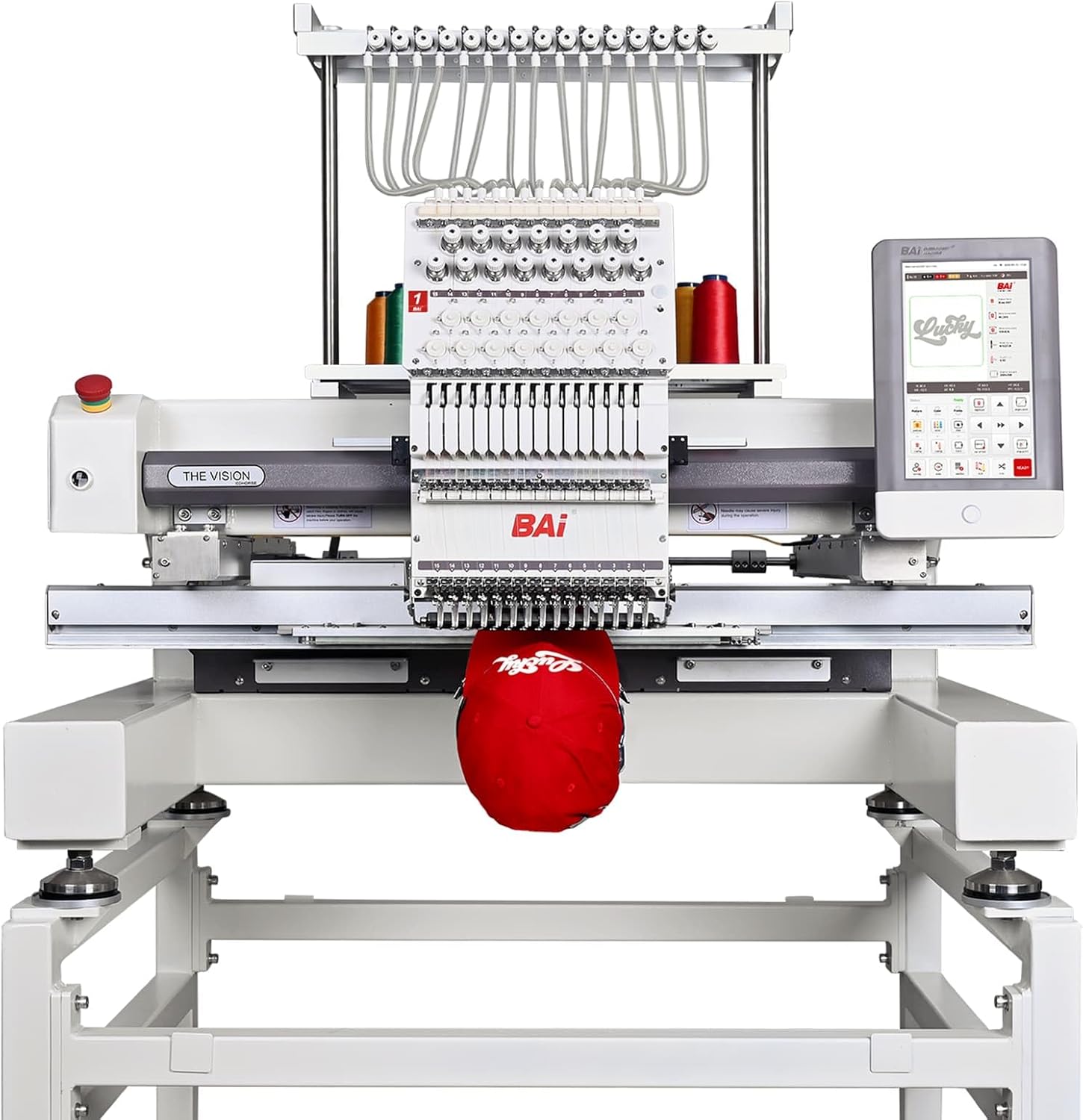
If your goal is to run embroidery like a real business instead of a side hobby, the BAi The Vision is one of the strongest options in this list. This is a 15-needle commercial embroidery machine with a large 20″ x 16″ embroidery area, a stated true 1200 SPM production speed, and a 10-inch touchscreen powered by Institch OS5. BAi positions it as a machine built for output, stability, and revenue, not just casual use.
That matters because commercial buyers usually care about how fast a machine can complete orders accurately day after day, not just how nice the product page sounds. The welded frame, premium component positioning, and emphasis on lower vibration suggest this machine is made for steady production rather than occasional embroidery on weekends.
A big reason this machine stands out is the balance between speed and business workflow. Many embroidery machines advertise fast stitching, but BAi specifically says The Vision is designed to maintain precision at 1200 SPM with stable stitching, accurate needle positioning, and even tension.
For a commercial user, that can mean fewer quality problems, fewer restarts, and more confidence when taking on paid jobs. The 15 needles also help cut down on thread changes, which is a major time saver when producing multicolor logos, uniforms, jackets, or cap runs. For shops doing repeat orders, that kind of efficiency is exactly where money is made.
Another strong selling point is cap work. BAi says this machine can reach up to 950 SPM on structured caps and highlights strong penetration, balanced tension, and rigid construction for cleaner results on hats. Cap embroidery can be frustrating on weaker or less stable machines, so readers who want to sell branded hats, team caps, or company merchandise may see this as a major advantage.
The large memory capacity, support for up to 100 million stitches or 1,000 designs, Wi-Fi transfer, and centralized file management also make it feel closer to a business production system than a beginner-grade embroidery unit.
What also makes The Vision different is that BAi is not only selling stitching hardware. It includes cost tools inside its software ecosystem for pricing jobs based on labor, rent, materials, and presets. That is a very business-oriented feature, and it could be valuable for shop owners who are still learning how to quote work profitably.
The machine is also large and heavy at 727 pounds, so this is not a casual “move it around the room” option. It needs dedicated space and a clear plan. That size may be a drawback for home users, but for a serious shop it may actually be a positive sign of stability.
A fair warning is that a machine like this can be more than some new users need. If someone is just learning commercial embroidery and only taking very light orders, the bigger price, size, and production focus may feel like too much.
But for readers who want to buy once and grow into the machine, BAi The Vision looks like a strong contender. It is best suited for buyers who care about large embroidery fields, cap work, fast output, Wi-Fi design transfer, and a more business-driven operating system.
Pros:
✔️ 15 needles for faster multicolor production
✔️ Large 20″ x 16″ embroidery area
✔️ Stated true 1200 SPM production speed
✔️ 10-inch touchscreen with Institch OS5
✔️ Wi-Fi transfer and business cost tools
✔️ Strong cap performance focus
✔️ Heavy welded frame for stability
Cons:
❌ Very large and heavy machine
❌ Better for serious shops than casual users
❌ May be too advanced or expensive for first-time hobby buyers
2. Smartstitch S1501 Plus Beast Embroidery Machine
Best For: Buyers who want a large-field 15-needle machine for commercial work, especially on caps, shirts, and flat garments.
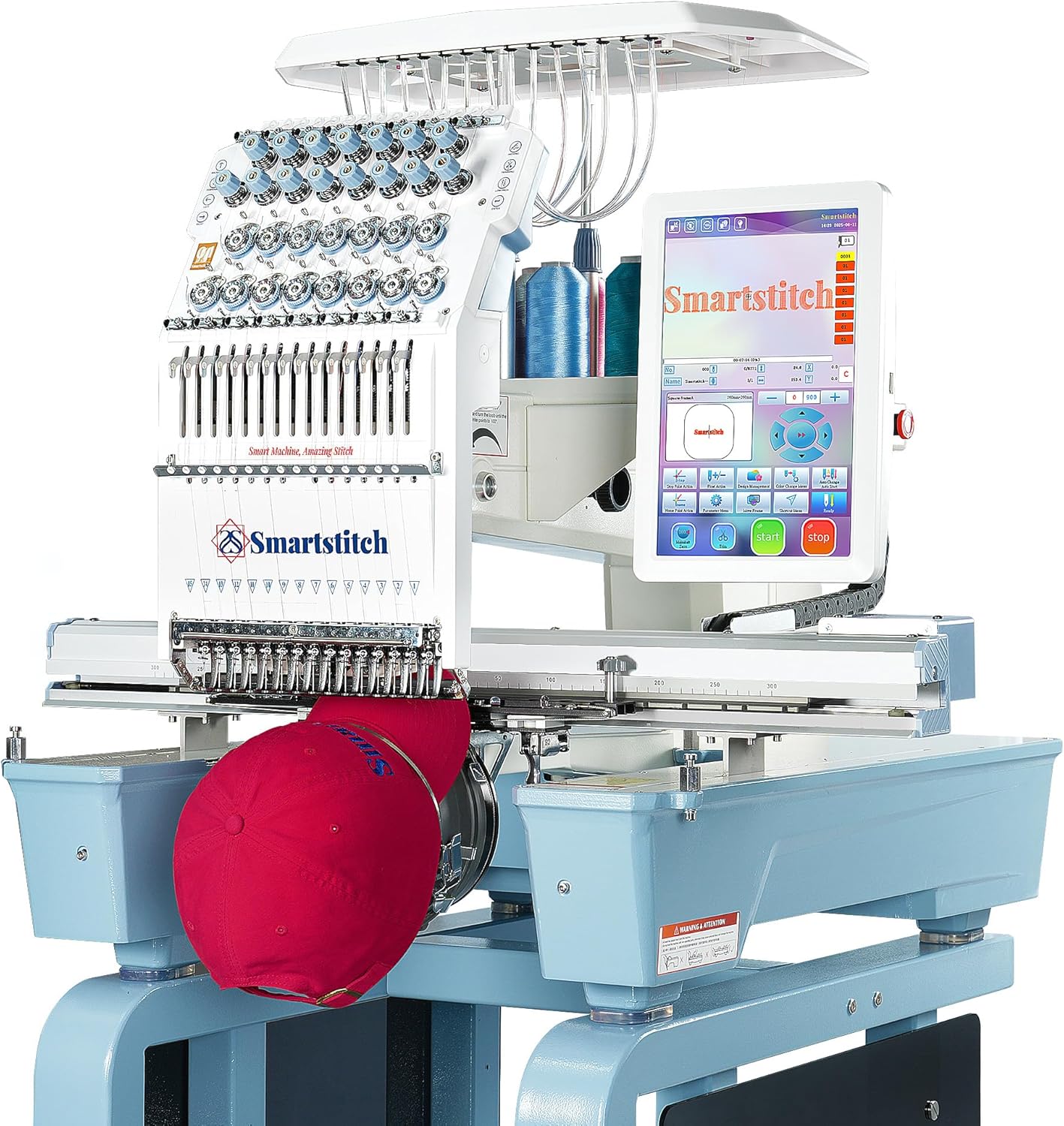
The Smartstitch S1501 Plus Beast is clearly aimed at people who want more room to grow than a starter commercial machine can offer. Its headline feature is the extra-large 24″ x 16″ embroidery area, combined with 15 needles, a 12-inch touchscreen, Wi-Fi capability, and a maximum speed of 1200 SPM.
Compared with many small-business embroidery machines, this larger field opens the door to bigger jacket backs, oversized layouts, large fashion graphics, and orders that would feel cramped on more compact machines. When a shop starts taking on larger custom jobs, embroidery area matters just as much as speed.
This model also looks attractive for users who want multi-use commercial flexibility. The listing says it is capable of embroidering caps, T-shirts, flat items, and more. That matters because many buyers are not only stitching one product type. A small business might do caps for one client, uniforms for another, tote bags for a local event, and hoodie logos the next day.
A 15-needle machine simplifies color-heavy designs, and a large touchscreen can reduce frustration during job setup. On paper, this machine looks built for that kind of mixed-order workflow.
The physical size is also worth noting. It shows dimensions around 33″ x 44″ x 35″ and a listed weight of 187 pounds. That puts it in a middle zone where it is still a real commercial machine, but not as massive as something like the BAi Vision. For some buyers, that may make it easier to fit into a home studio or small production room.
If your reader wants commercial performance without jumping straight to an extremely large industrial footprint, this is a practical selling point.
Because this product page is less detailed in the visible “About this item” content than some others, I would avoid overselling features that are not clearly shown. What is clearly visible is the 15-needle setup, the 24″ x 16″ large field, 1200 SPM max speed, 12-inch touchscreen, and Wi-Fi availability. From an affiliate writing angle, that still gives plenty to work with.
The main benefit is scale: larger embroidery area, easier multicolor production, and a machine that feels aimed at serious order-taking instead of occasional craft use. Buyers who already know they want a business machine but need more field size than many entry-level options may find this especially appealing.
The likely downside is that larger machines always come with a learning curve, and buyers should make sure they have enough space, enough order volume, and enough time to learn proper hooping, thread path management, and maintenance.
Still, if your audience is searching specifically for the best commercial embroidery machine, this is exactly the type of product they expect to see in the lineup. It looks built for production-minded users who want size, speed, and commercial flexibility.
Pros:
✔️ 15 needles for efficient multicolor embroidery
✔️ Very large 24″ x 16″ embroidery area
✔️ 12-inch touchscreen
✔️ Wi-Fi available
✔️ 1200 SPM max speed
✔️ Suitable for caps, shirts, and flat items
✔️ Good fit for growing commercial work
Cons:
❌ Still requires real commercial space and planning
❌ Likely more than a beginner hobby user needs
❌ Product page reveals fewer detailed business features than some rivals
3. Smartstitch S-1501 Commercial Embroidery Machine
Best For: Small businesses that want a proven 15-needle machine with a large embroidery area, cap capability, and strong beginner support.
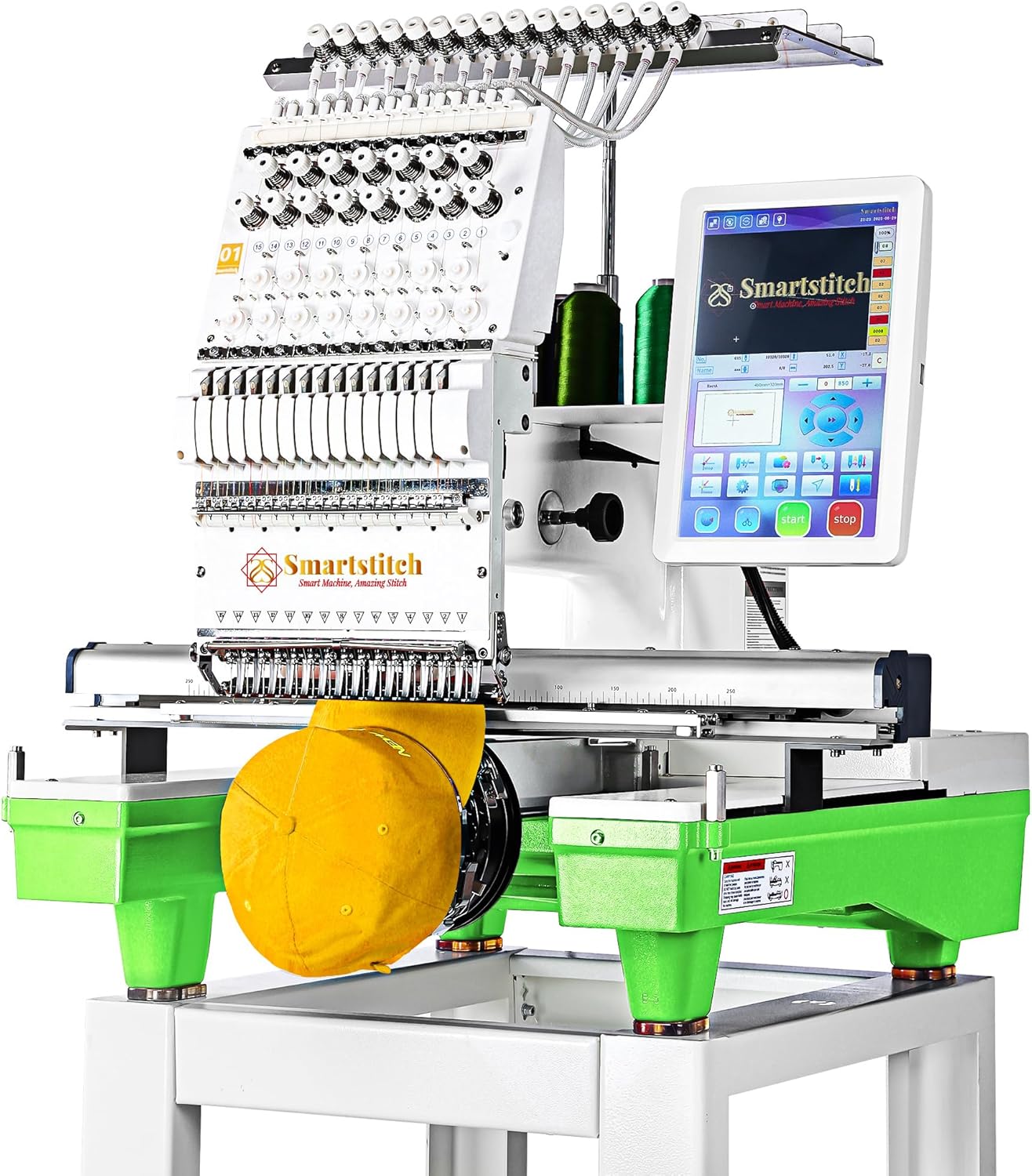
The Smartstitch S-1501 is one of the most attractive picks here for buyers who want a real commercial embroidery machine but still value guided setup and easier onboarding. It offers 15 needles, a 14″ x 20″ embroidery area, a 12-inch touchscreen, Wi-Fi support, and up to 1200 SPM.
That combination puts it well above consumer-level embroidery machines and makes it a legitimate option for paid production work. The machine is specifically marketed for 3D caps, flat work, T-shirts, and more, which helps position it well for users who want to sell custom hats, apparel, patches, and branded products.
What makes this one especially appealing is that Smartstitch seems to understand that many buyers are stepping into commercial embroidery for the first time. The brand repeatedly emphasizes manuals, video training, engineer support, and local support availability on related Smartstitch product pages.
Even though the visible details here are shorter, the S-1201 page from the same brand strongly highlights training, support groups, and step-by-step guidance, and that brand-level pattern matters because it tells you what kind of after-purchase experience Smartstitch is trying to sell. That can be a deciding factor for first-time business owners who are nervous about getting stuck with an expensive machine they do not know how to use.
The 14″ x 20″ field is also a sweet spot for many commercial buyers. It is large enough for substantial jacket back work, large left chest layouts, tote bags, hoodie fronts, and many flat items, while still being more compact than some huge production rigs.
The product dimensions around 28″ x 30″ x 32″ and the weight at 209 pounds, which suggests it is heavy enough to feel commercial and stable, but still more manageable than the largest machines in this roundup. That balance makes it easier to recommend to home-based shops or garage studios trying to grow into full production.
For commercial use, 15 needles are a major convenience. They let the operator load common business colors and reduce the need for constant thread changes. On repeat corporate orders or multicolor logos, that saves real time. The 12-inch touchscreen should also make the machine easier to navigate than smaller control screens.
If your reader wants a machine that feels professional without jumping all the way to the heaviest industrial setups, this one has a strong argument. It gives enough field size, enough needle count, and enough support focus to make it practical for a small shop.
The main caution is that commercial embroidery still comes with a learning curve. Multi-needle machines are easier in some ways, but they still require good digitizing, good hooping, good stabilizer choices, and patience during setup. That said, the S-1501 looks like one of the safer recommendations for users who want business capability plus a strong support culture.
Pros:
✔️ 15 needles for faster production
✔️ Large 14″ x 20″ embroidery area
✔️ 12-inch touchscreen
✔️ Wi-Fi available
✔️ Marketed for 3D caps, flats, and T-shirts
✔️ Good size for small business shops
✔️ Smartstitch brand emphasizes training and support
Cons:
❌ Still a commercial machine with a real learning curve
❌ Needs dedicated working space
❌ Serious investment for very small side hustles
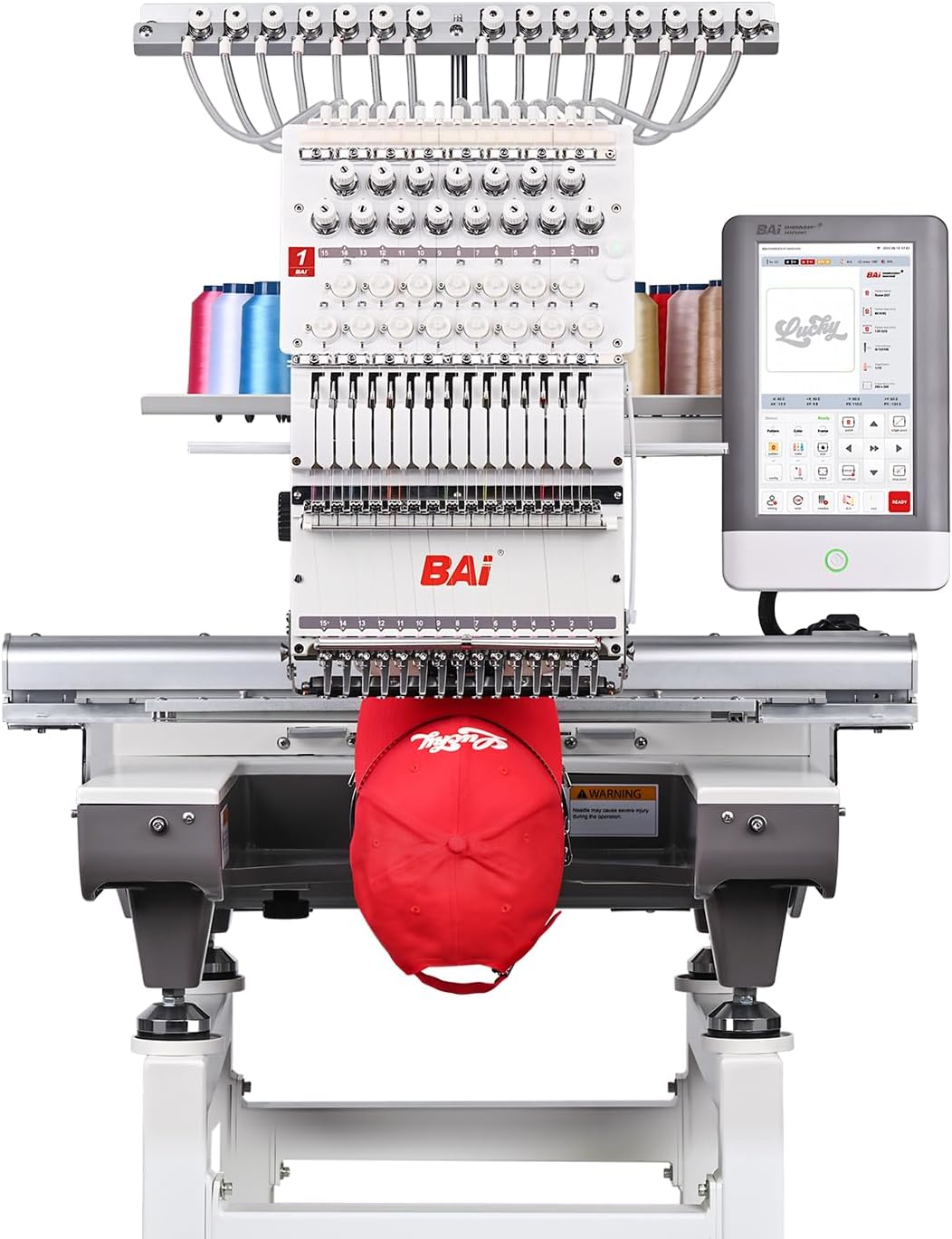
4. BAi The Mirror 15-Needle Commercial Embroidery Machine
Best For: Buyers who want a commercial multi-needle machine for hats and clothing with a big embroidery field and BAi’s touchscreen workflow.
The BAi The Mirror is another strong commercial option from BAi, and it looks like a very solid fit for embroidery sellers focused on caps, apparel, and regular production work. It features 15 needles, a 20″ x 14″ embroidery area, up to 1200 SPM, a 10-inch touchscreen, and Wi-Fi availability.
The product page positions it as a commercial embroidery machine for 3D hats and clothing, which makes it especially relevant for users who plan to sell custom caps, team gear, hoodie logos, branded shirts, or fashion embroidery.
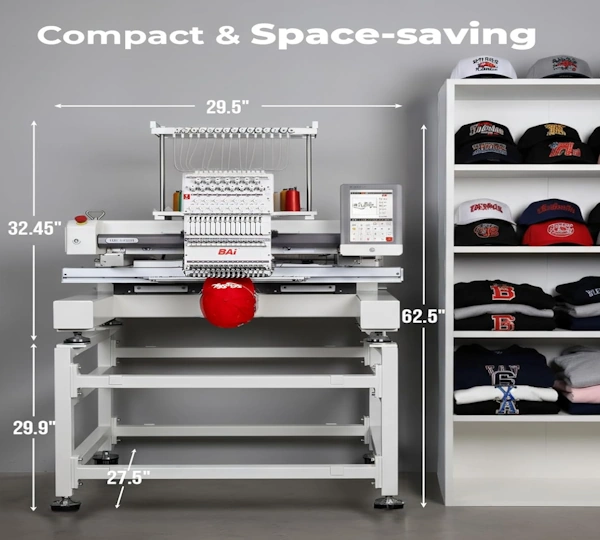
Compared with BAi The Vision, The Mirror appears more compact, with listed dimensions around 27.6″ x 29.5″ x 33.2″ and a listed weight of 391 pounds. That is still a serious machine, but it may feel more approachable for buyers who want BAi’s commercial platform without moving into the largest high-output format in the lineup. For many small shops, that can be a better match because space is often a real issue. A machine that is easier to place while still giving strong commercial features can be easier to justify.
The biggest appeal here is likely the balance between commercial speed and brand ecosystem. BAi uses the same general commercial language around high-speed multi-needle production, business use, and touchscreen operation. Readers looking for a machine that can handle hats well should pay attention to that 3D hat emphasis.
Cap embroidery is where lower-end machines often struggle, especially with alignment, tension, or stability. A commercial machine built with cap work in mind has a stronger chance of giving cleaner, more sellable results. That can matter a lot if hats are one of the most profitable products in the business.
Another thing to like is the large 20″ x 14″ area. It is big enough for back jackets, larger garment layouts, and custom work that needs more room than entry commercial units provide. The 15 needles also make it much easier to keep popular thread colors ready for daily orders. For business users, fewer stops means better rhythm and better throughput. The Wi-Fi availability is also convenient for design transfer compared with a USB-only workflow.
The main downside is similar to any serious commercial embroidery machine: it is not a casual plug-and-play toy. It needs setup space, operator patience, good designs, and proper maintenance. But for readers who want a genuine commercial embroidery machine from a known best seller in this category, BAi The Mirror deserves a place high on the list. It looks especially attractive for shops that want strong hat performance and a large field without stepping up to the largest BAi model.
Pros:
✔️ 15-needle commercial setup
✔️ Large 20″ x 14″ embroidery area
✔️ Up to 1200 SPM
✔️ 10-inch touchscreen
✔️ Wi-Fi available
✔️ Built for 3D hats and clothing
✔️ More compact than some bigger production models
Cons:
❌ Still heavy and space-demanding
❌ Better for business users than casual home crafters
❌ Requires commercial-level learning and upkeep
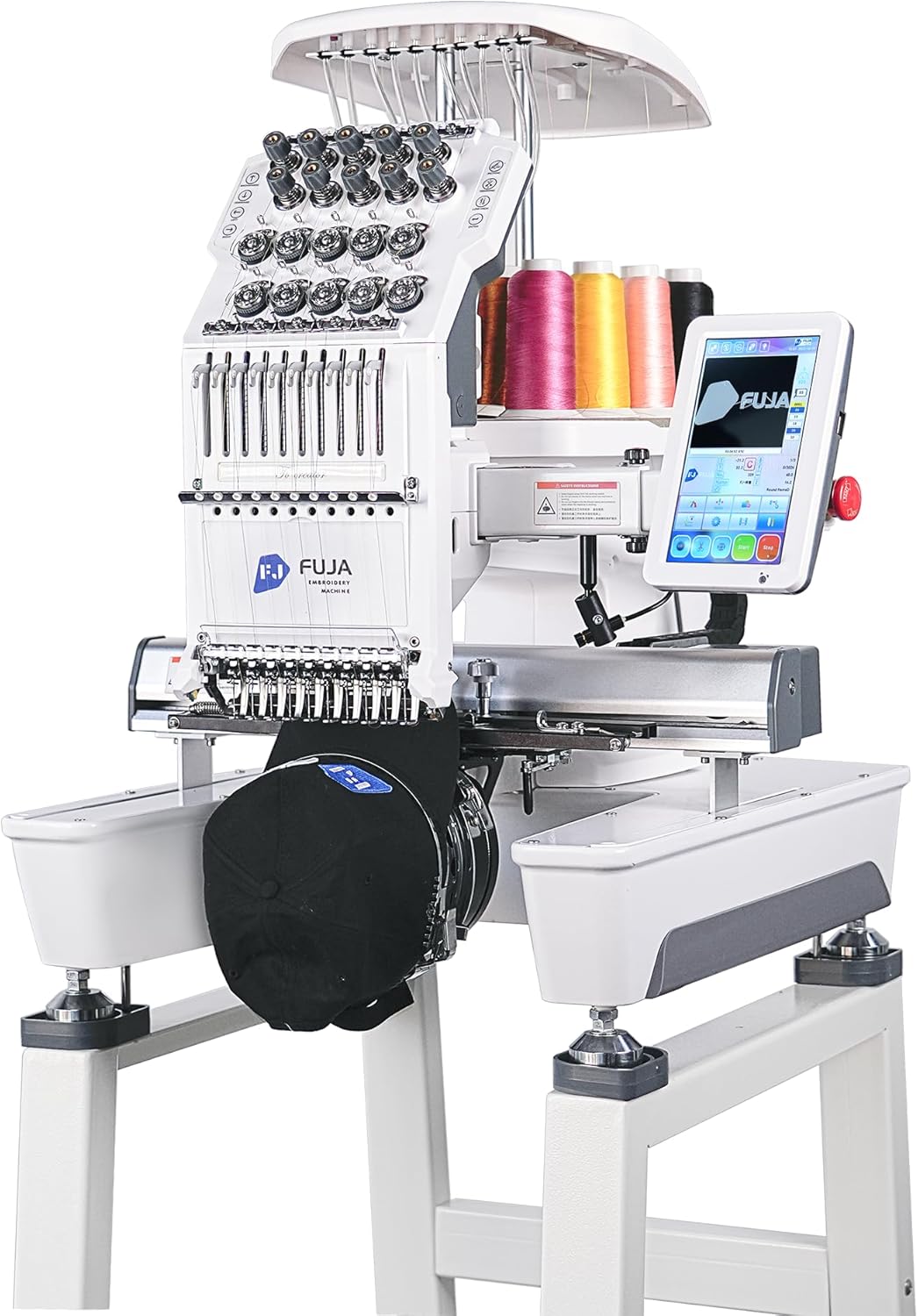
5. FUJA 10-Needle Commercial Beginners Embroidery Machine
Best For: Beginners who want a commercial embroidery machine with easier learning support, starter supplies, and a more approachable size.
The FUJA 10-Needle machine is one of the most beginner-friendly commercial options on your list, and that is exactly why it deserves attention. Not everyone searching for the best commercial embroidery machine is already running a busy shop. Many buyers are moving up from a home machine and want something commercial enough to take orders, but not so intimidating that they feel lost on day one.
FUJA leans directly into that need. The listing calls it a commercial beginner’s embroidery machine and highlights a 10-needle setup, 1200 SPM max speed, a 7-inch touchscreen, and a 9.5″ x 14.2″ embroidery area. It is specifically positioned for hats, flats, T-shirts, hoodies, patches, and more.
The most attractive part of this machine is not just the hardware. It is the support package around it. FUJA says the machine includes pre-installed training videos, online guidance from zero to full use, and even possible local on-site support if needed. It also mentions an exclusive user community and a professional support team to help users master the machine quickly.
That is a huge plus for first-time commercial buyers because the biggest fear is usually not the machine itself. It is the fear of getting stuck. A brand that talks directly about easing the learning curve is speaking to a very real buyer pain point.
Feature-wise, it still checks a lot of serious business boxes. FUJA highlights automatic thread trimming, automatic color changing, a self-lubricating system, thread breakage detection, physical buttons, laser positioning, and memory capacity up to 100 million stitches.
That means even though it is marketed toward beginners, it is not stripped down to the point of feeling toy-like. It is still built to help the operator take real embroidery work. The machine is also smaller than several other options in this roundup, with listed dimensions around 25″ x 33″ x 34″ and a listed weight of 289 pounds, which may help buyers working in tighter spaces.
Another practical benefit is the included starter pack. FUJA says it prepares a kit in the crate with bobbin thread, top thread, bobbins, easy-tear stabilizer, and embroidery needles, plus access to a pattern library. That is very useful for readers who want to start monetizing fast rather than hunting down every extra supply after delivery. For affiliate content, this is a strong conversion point because it reduces the feeling that the buyer still has to buy a dozen other things right away.
The obvious tradeoff is that 10 needles are fewer than 15. For some businesses, that is perfectly fine. For others doing heavy multicolor work every day, a 15-needle model may be more efficient. But for a first commercial machine, FUJA makes a lot of sense. It looks like a smart stepping-stone between beginner-friendly learning and real business capability.
Pros:
✔️ Beginner-focused commercial machine
✔️ 10 needles with up to 1200 SPM
✔️ 9.5″ x 14.2″ embroidery area
✔️ Automatic trim, color change, and thread detection
✔️ Training videos and support emphasis
✔️ Starter supplies included
✔️ Good for hats, T-shirts, patches, and hoodies
Cons:
❌ 10 needles offer less color capacity than 15-needle rivals
❌ 7-inch touchscreen is smaller than some competitors
❌ Advanced high-volume shops may outgrow it faster
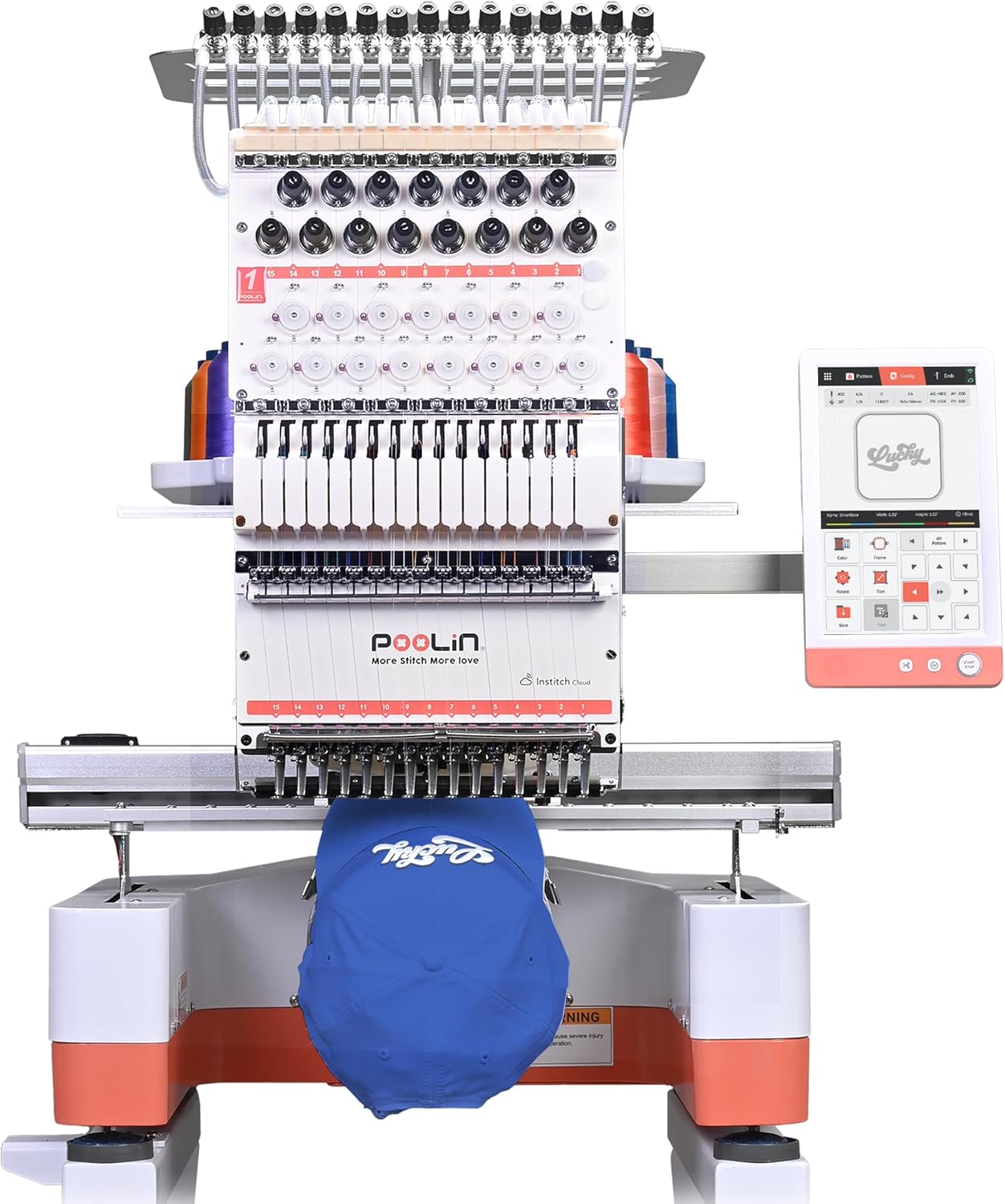
6. Poolin EOM 15-Needle Commercial Embroidery Machine
Best For: Small businesses that want 15-needle production, easier workflow, and a machine designed for daily orders without jumping to the biggest industrial format.
The Poolin EOM is a strong small-business commercial embroidery machine because it seems to focus on the exact things real order-based sellers care about: faster production, simpler workflow, and flexibility across products. The listing presents it as a 15-needle machine built for small businesses, hats, caps, and daily orders, with a 14.2″ x 9.5″ embroidery area, auto color change and trim, and Wi-Fi/USB design transfer.
It also uses a 9-inch color touchscreen and emphasizes a simple 3-step workflow: select design, set hoop, press start. That matters because many small-business owners do not want a machine that feels like operating a spaceship. They want something productive but approachable.
The 15-needle system is the star here. If your customer is moving up from a single-needle or low-needle machine, the jump in efficiency can be dramatic. Poolin specifically frames this as “real production,” allowing embroidery in up to 15 colors without constant thread changes. For repeat logo jobs or multi-color designs, that means less handling and fewer opportunities for mistakes.
It can also free up time so the operator can prep the next order, answer customers, or pack finished items while the machine runs. That productivity angle is exactly what commercial buyers want to hear.
Another very practical benefit is that Poolin says the EOM supports custom and third-party hoops. That can be a big deal for shops that already have hoop preferences or want more flexibility. The machine also comes with five hoops, a cap station, and two cap hoops, which adds real value right out of the box.
The embroidery area is not the largest in this roundup, but it is still large enough for many jackets, hoodies, tote bags, back patches, and daily apparel work. If the buyer is mainly doing hats, chest logos, patch runs, and common custom items, this field size may be more than enough.
Poolin also looks appealing from a support and adoption point of view. The listing says the digital user manual is available directly on the product page and mentions step-by-step tutorial videos on YouTube.
That lowers the barrier for first-time commercial users. Also shows this model as manufactured in 2025, with dimensions around 21.3″ x 28.4″ x 59″ and a listed weight of 165 pounds. That size makes it feel more manageable than some of the heaviest models while still looking serious enough for regular production.
The biggest limitation is the embroidery area compared with larger-field machines. Businesses focused heavily on very large jacket backs or oversized designs may want more room. But for many small shops, the Poolin EOM looks like one of the smartest “production without overkill” choices in the list.
Pros:
✔️ 15 needles for real multicolor production
✔️ Built for hats, caps, and daily orders
✔️ Auto color change and trim
✔️ Wi-Fi and USB design transfer
✔️ 9-inch touchscreen with simple workflow
✔️ Includes multiple hoops and cap setup
✔️ Supports custom and third-party hoops
Cons:
❌ Smaller embroidery field than some larger rivals
❌ Not ideal for very oversized commercial layouts
❌ Still needs business-level learning and setup discipline
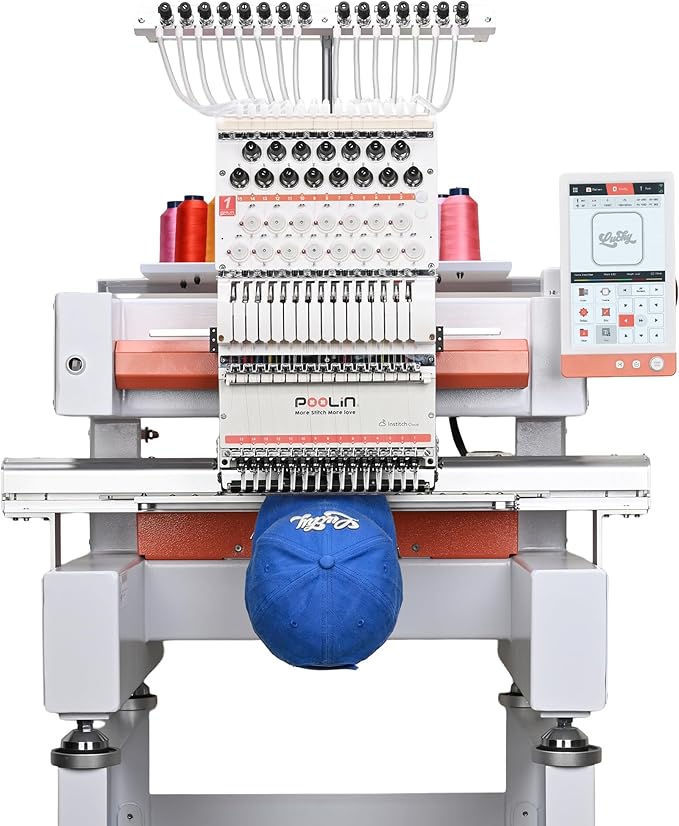
7. POOLIN EOV 15 Needle Embroidery Machine
Best For: Home shops and small studios that want a sturdier daily-production machine focused on repeat orders, hats, and apparel.
The POOLIN EOV looks like a more production-minded variation within Poolin’s commercial lineup. It is described as a 15-needle embroidery machine for small businesses and home shops, with the same 14.2″ x 9.5″ large area, but a stronger emphasis on daily order work, balanced motion, and reduced vibration.
That makes it appealing for readers who are less interested in just “having a multi-needle machine” and more interested in how stable the machine feels over longer work sessions. In real business use, that matters a lot. A machine can have good headline specs, but if it shakes, drifts, or needs frequent adjustment during long runs, the workflow suffers. Poolin is clearly trying to speak to that concern here.
The listing says it is designed for real daily customer orders and compares its 15-needle production favorably against single-needle, 6-needle, 10-needle, and 12-needle machines. Once colors are loaded, the machine can run multicolor designs with minimal intervention.
That is a strong commercial benefit because it means the owner can use time more efficiently instead of standing over the machine for constant changes. If your audience includes solo business owners who handle production, customer messages, order management, and shipping all at once, this point will connect well.
Poolin also highlights clean cap and apparel embroidery, repeat-order durability, a reinforced frame, and a balanced motion path to reduce vibration and maintain accurate stitches over long sessions. That kind of language is very helpful in an affiliate review because it frames the machine as a workhorse, not just a feature list.
The included accessory setup is also practical: multiple hoops, one cap station, and two cap hoops. Like the EOM, it supports larger custom work within the 14.2″ x 9.5″ field and can handle jackets, sweatshirts, hoodies, tote bags, and caps.
This model is heavier than the EOM, with 316 pounds and dimensions of around 24″ x 36″ x 48″. That may reflect its reinforced, more production-oriented build. For buyers, that can be either a plus or a minus. If they want more stability, it sounds good. If they have very limited space, it may be more difficult to place. So buyers may want to pay attention to review growth over time since the visible review count is still low compared with more established listings.
Overall, the EOV seems like a strong recommendation for buyers who want a commercial machine aimed at real daily output, especially in a home shop or small studio setting. It feels less like an entry toy and more like a production partner for repeat custom work.
Pros:
✔️ 15 needles for efficient daily production
✔️ Built for small shops and home studios
✔️ Reinforced frame and balanced motion path
✔️ Strong focus on reduced vibration and stitch accuracy
✔️ Good for hats, caps, jackets, and apparel
✔️ Includes hoops and cap accessories
✔️ Designed for repeat-order workflows
Cons:
❌ Larger and heavier than some compact alternatives
❌ Smaller field than extra-large commercial machines
❌ Newer listing with fewer reviews visible so far
8. Smartstitch S-1201 Compact Commercial Embroidery Machine
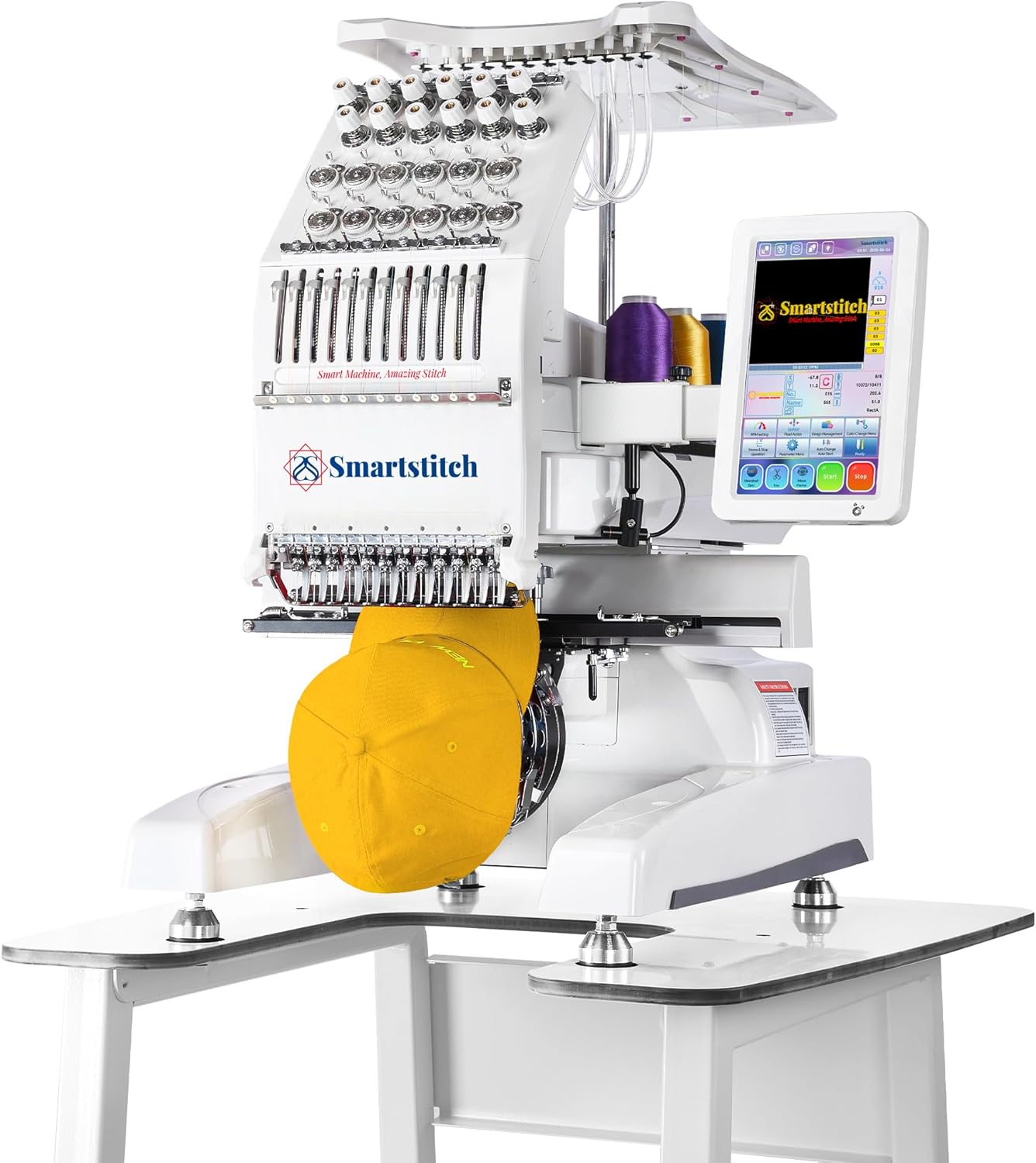
Best For: First-time commercial buyers who want a compact 12-needle machine with training, starter supplies, and home-business flexibility.
The Smartstitch S-1201 is one of the most practical “first real commercial machine” choices in your list because it combines business-ready features with a smaller footprint and clear beginner support. It features it as a 12-needle compact commercial embroidery machine with up to 1200 SPM, a 10-inch touchscreen, Wi-Fi, and a 9.5″ x 12.6″ embroidery area.
The product description specifically markets it as “your first commercial embroidery machine,” which tells you exactly who it is trying to win over: users leaving the hobby level and stepping into paid work.
What makes this machine compelling is the mix of compact size and real commercial features. Smartstitch says it is easy to move and store, with compact dimensions and lighter weight compared with larger commercial machines, but still capable of stitching on denim, canvas, leather, vinyl, caps, shoes, bags, and other industrial-style applications.
That gives the reader confidence that “compact” does not mean weak. It simply means more manageable for a home embroidery room, garage setup, or small office studio. For people starting a business from home, that is a powerful angle.
The feature list is strong for this category. Smartstitch highlights a 10-inch LCD touchscreen, 1200 SPM max speed, laser positioning, automatic color change, 100 million max memory stitches, Wi-Fi/USB file transfer, and included starter supplies such as embroidery threads, stabilizers, and bobbin threads.
It also heavily emphasizes training and technical support, including operation manuals, video trainings, online help from experienced engineers, and local support availability. The customer reviews also repeatedly mentions ease of use, setup help, training quality, support, and value for money. That is especially helpful for affiliate content because it tells you what real buyers seem to appreciate most.
From a business angle, 12 needles are a nice middle ground. It gives more color convenience than a 10-needle model, but may still feel simpler and more affordable than jumping straight to 15 needles.
The embroidery area is smaller than the giant field machines, so it will not be the best for extra-large back pieces. But it still looks very capable for hats, flats, T-shirts, bags, shoes, and many profitable custom products. For many first-time sellers, that is enough to start earning and learning at the same time.
The main downside is that bigger, faster-growing businesses may eventually want more field size and more needles. Still, for a first commercial step, the S-1201 feels very well positioned. It is one of the easiest machines in this roundup to recommend to someone who wants to launch a home-based embroidery business without being crushed by a huge industrial setup.
Pros:
✔️ 12 needles offer a strong middle-ground setup
✔️ Compact machine for home business use
✔️ 10-inch touchscreen and Wi-Fi
✔️ Up to 1200 SPM
✔️ Supports denim, leather, vinyl, caps, shoes, and bags
✔️ Starter pack included
✔️ Strong training and technical support focus
Cons:
❌ Smaller embroidery area than large-field competitors
❌ 12 needles may be limiting for very color-heavy high-volume work
❌ Growing businesses may outgrow it over time
Buyer’s Guide: How to Choose the Best Commercial Embroidery Machine
1. Decide if you need a starter commercial machine or a production machine
Some machines here are clearly better for beginners moving into business, such as the FUJA 10-needle and Smartstitch S-1201, because they emphasize training, support, starter supplies, and easier adoption. Others, like BAi The Vision, are much more production-driven and make more sense for buyers who already have order volume or want to build toward serious commercial output. Choosing too big too early can waste money, but choosing too small can limit growth.
2. Look closely at the needle count
A 10-needle machine can absolutely run a small embroidery business, but a 12-needle or 15-needle machine reduces color changes and can make repetitive multicolor jobs more efficient. If your reader expects lots of logos, uniforms, cap orders, and branded apparel, 15 needles can save time every single day. If they are just starting out, 10 or 12 needles may be a more realistic step.
3. Match the embroidery area to the products you want to sell
Larger areas like 20″ x 16″ or 24″ x 16″ are better for oversized layouts, jacket backs, and bigger designs. Mid-size fields like 14″ x 20″ or 14.2″ x 9.5″ can still handle many profitable products such as hats, hoodies, patches, bags, and chest logos. Buyers should not pay for a giant field if they mostly sell small logos, but they also should not buy too small if they want larger apparel work.
4. Do not ignore training and support
Commercial embroidery has a learning curve. Machines from FUJA, Smartstitch, and Poolin all visibly mention manuals, videos, online help, or support guidance. That may sound secondary, but it is often the difference between getting profitable fast and feeling stuck after delivery. For first-time buyers, support is not a bonus. It is a core buying factor.
5. Think about space, weight, and daily workflow
Some of these machines are truly large and heavy. BAi The Vision is listed at 727 pounds, while other models are much more compact. A reader should think about where the machine will sit, how it will be moved, whether room-of-choice delivery is important, and whether they want a machine that can comfortably live in a home studio or needs a dedicated shop area.
FAQs
Which is the best commercial embroidery machine for beginners?
For beginners, the FUJA 10-needle and Smartstitch S-1201 stand out because both listings strongly emphasize training, guided support, and easier setup. The FUJA even calls itself a commercial beginners machine, while the Smartstitch S-1201 is marketed as a first commercial embroidery machine.
Which machine is best for a serious embroidery business?
BAi The Vision looks like one of the most business-focused options because of its 15 needles, 20″ x 16″ area, true 1200 SPM positioning, welded-frame stability, cap-performance claims, and software tools for pricing and file management.
Which commercial embroidery machine is best for hats?
Several in this list target hat work, especially BAi The Vision, BAi The Mirror, Smartstitch S-1501, and the Poolin EOM/EOV models. BAi The Vision specifically highlights structured cap performance up to 950 SPM, while the others also market cap embroidery as a core use case.
Is Wi-Fi transfer worth having on a commercial embroidery machine?
Yes, for many users it is convenient because it makes design transfer easier than relying only on USB. Several of these machines highlight Wi-Fi availability or Wi-Fi/USB transfer as part of their workflow.
How many needles do I really need?
That depends on your order type. Ten needles can be enough for a beginner commercial shop. Twelve needles offer a nice middle ground. Fifteen needles are better for faster multicolor work and more serious production flow.
Conclusion
The best commercial embroidery machine is not the same for every buyer. If the reader wants the most production-oriented option with a very large field and business-minded software, BAi The Vision is one of the strongest picks. If they want large-field commercial flexibility, the Smartstitch S1501 Plus Beast is attractive.
If they want a small-business-friendly 15-needle machine with a practical setup, the Smartstitch S-1501 and Poolin EOM are both strong choices. If beginner support matters most, the FUJA 10-needle and Smartstitch S-1201 are easier recommendations. And if the goal is repeat-order reliability in a home shop or studio, the Poolin EOV looks promising.
The smartest affiliate angle is to match the machine to the buyer’s real stage. A first commercial machine should feel learnable. A growth machine should feel scalable. A production machine should feel stable and profitable. That is how this keyword converts well: not by naming one winner for everyone, but by helping the reader feel that the right machine for their business is clear.
