
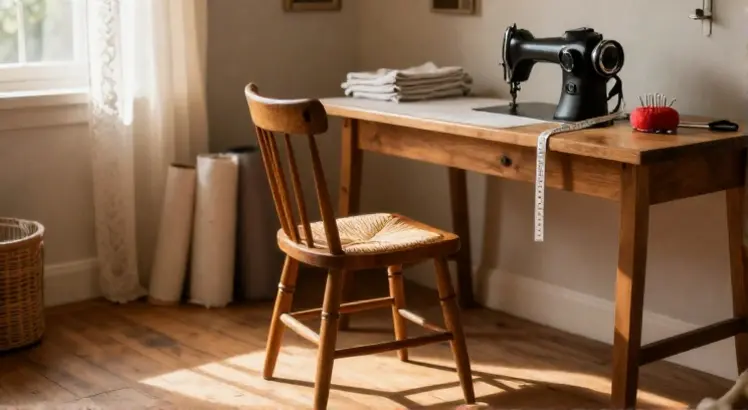
Sitting comfortably at your sewing machine is not a luxury, it is a necessity. For a person who stands 5 feet tall, standard office chairs often fall short. They leave you perching on the edge, hunching your shoulders, or dangling your feet. This disrupts your posture and leads to nagging back pain. Finding the correct sewing chair height for a 5ft person transforms your craft room.
It aligns your eyes with the needle, keeps your feet flat on the floor, and lets you sew for hours without fatigue. This guide explains exactly how to measure your ideal seat position, which features matter most for petite frames, and the specific chairs that meet those strict requirements.
Before you start shopping, understand that the standard desk chair seat height ranges from 17 to 20 inches. This is often too high for a 5-foot sewist. Your optimal chair position directly influences your ability to control the fabric and maintain control over detailed seams. A chair that is too high forces your wrists into an awkward angle. A chair that is too low makes you shrug your shoulders.
Your goal is to find a seat height that allows your elbows to rest at a 90-degree angle when your hands are on the sewing machine bed. Explore the details of specialized chairs for shorter crafters to see how the right design can improve your stitching accuracy immediately.
Why Seat Height Is the Single Most Critical Measurement
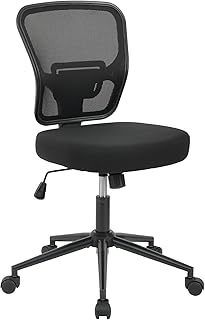
Armless Office Desk Chair Height Adjustable, Ergonomic High Back Mesh Task Chair
Check PriceThe ergonomic foundation of a sewing station starts from the floor up. Your chair height dictates the angle of your knees, hips, and spine. For a 5-foot individual, the femur is typically shorter than the standard adult measurement used to design office furniture. You must look for a minimum seat height that drops low enough to let your thighs parallel the ground.
When you sit down, your knees should form a comfortable 95 to 110 degree angle. Your feet must rest solidly flat, not just the toes touching the floor. This stability reduces pressure on the lower back and prevents the circulation problems that come from the seat edge cutting into your legs. Measure your own ideal chair height by measuring from the floor to the back of your knee while wearing your sewing shoes. This number, usually between 14 and 16 inches for someone 5 feet tall, is your target seat height.
Without this foundation, your body will compensate. You might cross your legs, which twists your pelvis. You might slide forward, losing back support. These positions strain the intricate small muscles along your spine. Over a long quilting session, that strain turns into sharp pain between the shoulder blades. The OSHA guidelines on chair height recommend adjustable chairs precisely because a fixed height cannot serve every body. The same principle applies even more stringently to sewing, where you lean forward slightly. Ignoring this leads to chronic discomfort that can force you to abandon your hobby.
Measuring Your Perfect Sewing Posture at 5 Feet Tall
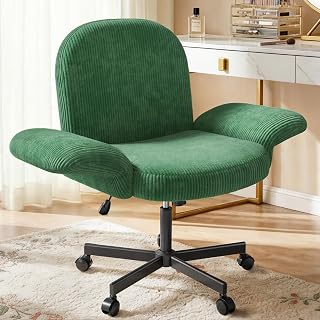
HUANUO Criss Cross Office Chair with Adjustable Armrests, Deep Green
Check PriceGetting the math right requires a simple tape measure and a hard-backed chair or stool. Sit with your back straight and your knees bent. Measure the distance from your heel to the underside of your thigh, right behind the knee. This is your popliteal height. For most women who are 5 feet tall, this dimension falls precisely in the 14.5 to 15.5 inch range. Now measure the height of your sewing table or machine bed. The ideal gap between the chair seat and the top of your work surface should allow your forearms to slope slightly downward.
Your wrists must remain straight, not bent upward or downward. If your sewing table is a fixed 28 inches high, you likely need a seat height of roughly 16 to 17 inches to bring your elbows to the correct position. A beautifully designed chair for long sewing sessions will include a gas lift that can hit this exact low range while providing adequate padding.
Do not rely on the chair marketing specification alone. Many chairs say they adjust starting at 17.5 inches. That half inch matters immensely. You can test this by sitting on a stack of books until you find the perfect height, then measuring that pile. If your chair can only go down to 18 inches and you need 15 inches, no lumbar cushion will fix the numbness in your feet. A footrest becomes a mandatory accessory if your chair is slightly too high, but a chair that goes low enough naturally is always the superior solution.
Seat Depth and How It Affects a 5ft Frame
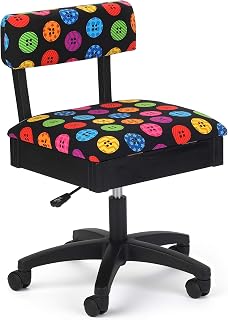
Arrow Sewing H8013 Adjustable Height Hydraulic Sewing and Craft Chair
Check PriceHeight alone does not guarantee comfort. The depth of the seat pan is where many compact chairs fail a petite user. A standard seat depth is 18 to 20 inches deep. For someone with a shorter femur, this pushes the back of the knees directly against the hard edge of the cushion. This pressure compresses blood vessels and forces you to sit on the front half of the chair, defeating the backrest.
Look for a seat depth of 15 to 17 inches. This allows you to sit all the way back and still have a two-finger gap between the seat edge and your calf. A waterfall seat edge, which curves downward at the front, further reduces pressure and promotes healthy circulation. Mesh seats often provide a little more give, but the depth measurement remains the key statistic to check before buying.
A chair that fits your depth also stabilizes your pelvis. When your back is against the backrest, your core muscles can relax. You are not using them to brace yourself. This reduces fatigue and lets you focus on precise needle placement. Armless chairs, when scaled properly, give you the freedom to rotate and reach for scissors without obstruction. The combination of a shallow seat and an ultra-low minimum height forms the holy grail of sewing ergonomics for the 5-foot sewist.
The Advantage of Armless Designs for Vertical Movement
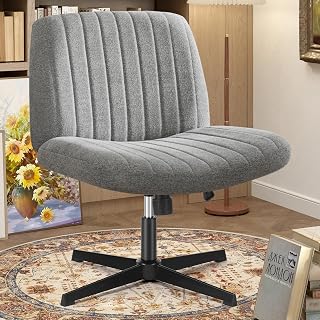
OLIXIS Criss Cross Chairs, Vanity Chair, Home Office Desk Armless Wide Seat
Check PriceSewing requires constant lateral reaches. You pivot to iron, you stretch for pins, and you guide large quilts through narrow throats. Fixed armrests block these natural motions. For a shorter person, armrests can also clash with the underside of the sewing table, preventing you from scooting close enough. An armless chair offers total freedom.
However, the chair must still provide a stable, wide base so you feel secure when leaning to the side. Criss-cross chairs and wide vanity seats excel here. They use a sturdy metal base with a thick, padded cushion that allows you to tuck your legs up or sit cross-legged safely. This informal sitting style is popular among sewists who need to shift weight frequently. You can change your foot position without altering the precise chair height.
While armless designs promote mobility, they demand a strong backrest. If the chair has no arms, it must have well-shaped back support. Look for a high-back mesh design or a curvaceous mid-back that cradles your lumbar spine. Without upper body support, your trapezius muscles carry the burden of holding your head steady while you thread needles. An armless chair with a sculpted backrest distributes your weight and keeps your spine neutral, making it a top choice for a 5ft sewist who values fluid movement.
Lumbar Cushions and Back Support Geometry
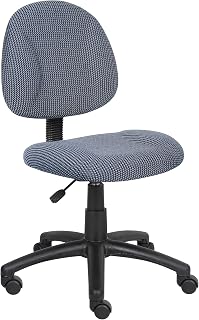
Boss Office Products B315-BE Perfect Posture Delux Fabric Task Chair
Check PriceA chair cannot just fit your height, it must fit the curve of your spine. Petite sewists often find that the lumbar bump on standard chairs hits them between the shoulder blades instead of the lower back. This misalignment pushes your shoulders forward and rounds your entire torso. Prioritize chairs with either no aggressive built-in lumbar or, even better, adjustable lumbar support that slides down to your sacral curve.
You need that support to fill the gap in your lower back where natural lordosis occurs. The correct support reduces disc pressure significantly. A cushion that is proportioned for a smaller back prevents you from slumping against a flat back panel. Fabric task chairs often provide a more forgiving, nestled feel than rigid plastic shells.
If you find a chair with the perfect height but the lumbar curve sits too high, you can sometimes modify it with a separate low-profile memory foam roll. Place the roll at belt level to create a customized support point. However, selecting a chair designed for correct back contact from the start eliminates this hassle. A mid-back chair often hits the correct spot for a 5ft person more naturally than a high-back executive chair.
Rolling Mobility and Floor Protection
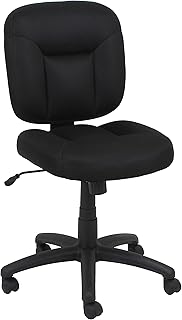
Amazon Basics Low-Back Armless Office Desk Chair
Check PriceSewing often requires rolling between the machine, the ironing board, and the cutting table. Smooth-rolling casters save your hips from twisting strain. However, the added height from caster wheels can raise a chair by an inch. For a 5-foot person, every inch counts. Look for low-profile chairs where the cylinder sinks deeply into the base, or choose chairs with hooded double-wheel casters that distribute weight without adding bulk.
Soft rubber wheels that glide on hardwood floors also prevent you from having to push hard with legs that may not fully reach the floor. If you find a chair that meets your height requirement but rolls too easily, a simple carpet mat or casters with brakes gives you stability when you need to anchor yourself for precise stitching.
Low-back armless task chairs often fit exceptionally well under sewing cabinets. Their compact footprint allows you to tuck completely under the table lip, conserving precious space in a small craft room. These chairs tend to have simpler mechanisms that lower to the 15 to 17 inch sweet spot without breaking the bank. They are a workhorse solution for the practical sewist.
Comfort Padding and Breathable Mesh Upholstery
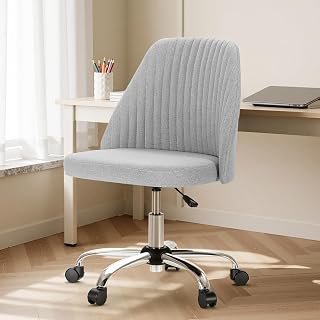
DUMOS Home Office Chair, Comfy Desk Chair with Rolling Wheels Armless
Check PriceLong hours at the machine generate heat. A thick foam cushion that does not breathe becomes uncomfortable. Mesh upholstery is a game-changer for sewists who sit for three or four hour stretches. It conforms to your shape and allows air to circulate, keeping you cool and focused. A well-constructed seat pan should have a contoured foam density firm enough to prevent bottoming out.
For a lighter person, 5 feet tall, a medium firmness often feels perfect because your weight will not overly compress the cushion. Plush, overly soft seats might feel welcoming but eventually cause your hips to sink unevenly, tilting your pelvis backward. Choose a chair that offers a balanced, supportive sit right out of the box.
The fabric quality matters for durability in a sewing room. Stray threads, pins, and lint are constant. A smooth, tightly woven mesh or easy-clean leatherette resists snags. Avoid looped fabrics that can catch on scissors or zippers hanging from your project. The chair should function as a clean, slick workstation accessory that complements your workflow rather than hindering it.
Short Stools and Low-Profile Seating for Specialized Tasks
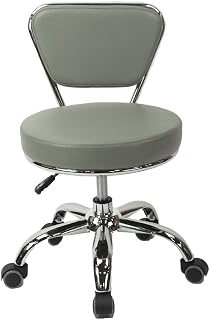
MAYAKOBA Dayton Garage Rolling Seat (Storm Grey)
Check PriceNot every sewing task happens at a standard table. If you use a low cutting table, sit at a serger on a stand, or work on a floor-length hem, a shorter rolling stool can be transformative. These stools often adjust from as low as 13 inches up to 17.5 inches. This range fits a 5ft person like a glove. The smaller diameter seat leaves your legs free to move.
A heavy-duty chrome base with five hooded casters ensures a stable roll without tipping. The pneumatic adjustment lever is usually easy to reach and operate without straining your shoulder. Having a dedicated low stool prevents you from hunching over a low work surface, which would compress your diaphragm and accelerate fatigue.
When selecting a stool, ensure the padded top is at least 13 inches in diameter. A wider cushion provides better weight distribution for your sit bones. The stool can also double as a quick-access seat for your embroidery machine or a spare chair for a crafting buddy. Its compact footprint stores neatly under a counter when not in use, making it a versatile addition to a small sewing studio.
Wide Fabric Vanity Chairs for Flexible Sitting
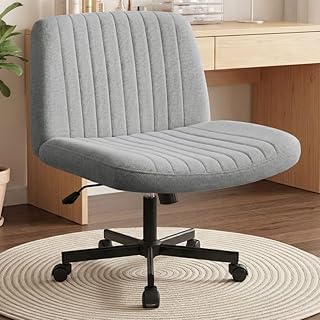
Orange Factory Criss Cross Chair, Wide Fabric Vanity Desk Seat
Check PriceCriss-cross chairs have surged in popularity for good reason. Their wide, flat seat surface invites you to sit on your feet, tuck one leg under, or stretch out. This shifting of leg positions helps prevent static pressure points. A petite sewist who tires of sitting in one posture can simply cross her ankles or fold her legs onto the padded platform without needing to lower or raise the chair.
The base height on these chairs is typically adjustable within a lower range, often starting at around 16 to 17 inches. Combined with a sturdy, wide metal foundation, they feel grounded and secure. The fabric upholstery offers a soft, warm touch that suits long, cozy crafting hours. These chairs also blend beautifully into a bedroom corner sewing nook or a dressing and craft area.
Keep in mind that a wider seat may push you too far from the machine if the table is shallow. Always measure the distance from your belly button to the needle plate when seated. If the wide cushion adds depth, compensate by choosing a chair with a thinner backrest profile or one that allows you to sit more forward naturally. The ability to change position offsets the slight increase in depth for many users.
Small PU Leather Chairs with Lumbar Support for Petite Frames
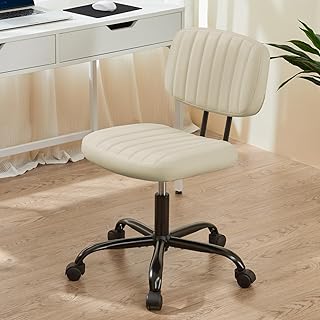
Sweetcrispy Office Desk Chair, Small Vanity Chair, Lumbar Support
Check PriceFor those who prefer a clean, modern aesthetic that is easy to wipe down, PU leather chairs offer a practical solution. They are often scaled down intentionally for vanity use, which makes them a perfect match for a 5-foot sewist. The key advantage is the inherently shorter back and lower seat height designed for makeup tables and small desks.
These chairs often feature a subtle embossed lumbar pad that aligns nicely with a shorter back. The armless design keeps the profile slim, allowing it to slide completely under a standard sewing cabinet without scratching the surface. The faux leather repels water and can be quickly cleaned of lint and chalk dust, keeping your sewing area tidy.
Select a model with a reliable SGS-certified gas cylinder. The weight range should be well within your bracket, ensuring the lift mechanism operates smoothly even with a lighter load. Squeaky or jerky lifts indicate poor quality and can be startling when you need to micro-adjust your height. A simple pneumatic lever under the seat should be easy to reach and activate without requiring you to bend over excessively.
Compact Desk Chairs for Tiny Sewing Nooks
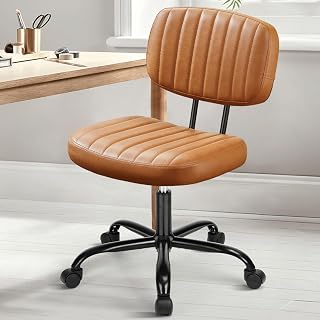
DUMOS Small Desk Chair, Home Office Chair, Lumbar Support
Check PriceSpace is often at a premium. A compact chair built specifically for small spaces removes bulk without sacrificing ergonomic principles. These chairs are engineered to accommodate users from around 4 foot 11 to 5 foot 3. The backrest height is typically lower, hitting at the perfect upper lumbar region to support the natural curve. The armless construction means there is less frame to bump into tables or walls.
Many of these small desk chairs feature a tilt tension knob that lets you adjust the recline resistance. A lighter user needs a mechanism that can be set to a very light tension, so you can actually rock back without having to throw your body weight into it. Check for a foot ring or a low base that allows you to keep your feet planted while gently reclining.
Wheels on these smaller chairs are usually nylon and suitable for hard floors or low-pile carpet. If your sewing room has thick shag carpet, consider replacing the casters with rollerblade-style wheels that glide effortlessly. This simple upgrade transforms a budget-friendly compact chair into a highly mobile sewing assistant that moves with you as you guide quilts through the machine.
Drafting Chairs for Stand-Up and Hybrid Cutting Tables
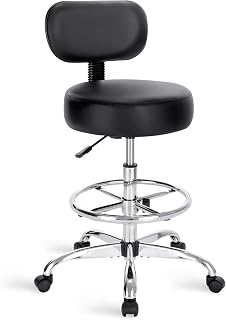
SUPERJARE Drafting Chair with Backrest, Adjustable Foot Rest Rolling Stool
Check PriceMany sewists use adjustable-height tables that can switch between sitting and standing. A drafting chair with an extra tall gas cylinder and a supportive foot ring is essential here. However, for a 5-foot person, the critical feature is that the chair can dip low enough for sitting mode. A high-quality drafting stool will adjust from around 20 inches all the way up to 28 inches.
When fully lowered, the 20 inch seat might still be too tall for standard sitting. Look for a drafting chair that actually starts its range at 16 or 17 inches. Some models feature a super-low base option. The foot ring must be fully adjustable in height and large enough to support both feet simultaneously. A polished chrome ring allows you to pivot your feet freely as you swivel between the cutting mat and the sewing head.
The backrest on a drafting chair needs to be angle-adjustable, not just fixed. When you perch at a higher height, you need a slight forward tilt to keep your back engaged. When you drop down to sew, you want the backrest upright against your lumbar. A versatile drafting stool eliminates the need for two separate chairs in the room, but only if the vertical range truly accommodates your 5-foot stature.
Multi-Purpose Rolling Stools with Foot Rests
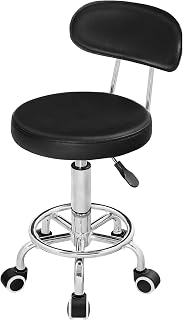
HOOBRO Height Adjustable Rolling Stool, Multi-Purpose Office Desk Chair
Check PriceA rolling stool with a thick, height-adjustable cushion and an integrated foot ring offers perhaps the most adaptable seating for a 5-foot sewist. The stool concept strips away the bulky backrest, which can sometimes interfere with leaning over a large project. A well-designed multi-purpose stool will lower to 14 or 15 inches, far below standard chairs.
This ultra-low setting is perfect for working on low tables or reaching into bins on the floor. The footrest ring, usually a thick steel hoop, provides a stable platform when you raise the seat to work at a standard desk height. Your feet rest securely on the ring, preventing dangling. The 360-degree swivel function makes it easy to turn and grab supplies without twisting your spine.
Padding thickness matters here because you will be on this stool for long periods without the option to lean back. Look for a seat cushion at least 3 inches thick and covered in a durable, easy-clean fabric. The heavy-duty metal base should be weighted to prevent tipping when you lean to the side. These stools are not just for garage use; they have evolved into stylish, practical pieces for a modern craft studio. They enforce an active sitting posture that keeps your core engaged and your spine naturally aligned.
Finding the correct sewing chair height for a 5ft person is a precise science that rewards you with a lifetime of comfortable crafting. By focusing on the low minimum seat height, a shallow seat depth, and flexible features like armless designs and adjustable foot rings, you create a workstation that fits your body perfectly. The chairs highlighted in this guide all offer the specific dimensions and ergonomic features necessary to support a petite frame. Invest in the one that matches your sewing style and watch how your endurance and enjoyment flourish.
