
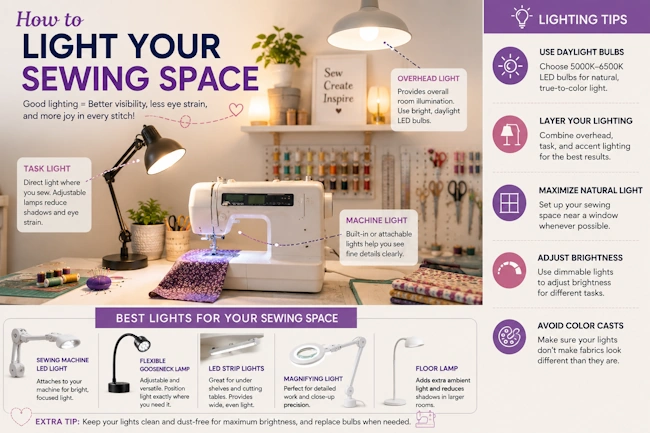
If you have ever squinted at a dark seam, mismatched thread color, or ended a sewing session with throbbing eyes, you already know that lighting is not a nice-to-have upgrade for your craft space. Learning how to light your sewing space properly is one of the highest-impact changes you can make, whether you are stitching your first tote bag or hemming custom silk gowns. Poor lighting does not just slow you down; it leads to costly mistakes, unnecessary eyestrain, and projects you have to rip out and redo entirely.

Sewing Machine Light LED Lighting (30LEDs) 6 Watt Multifunctional Flexible Gooseneck Arm Work Lamp with Magnetic Mounting Base for Workbench Lathe Drill Press 2 Pack Silver
Check PriceWhy Proper Sewing Space Lighting Matters
The Hidden Costs of Poor Lighting
Most sewers focus on buying the best sewing machine or premium fabric, but skip lighting entirely. Over years of sewing, I have thrown out entire projects because I could not see that a dark navy thread clashed with black fabric under dim yellow ceiling lights. Beyond wasted materials, poor lighting causes chronic eye fatigue, headaches, and even neck strain as you lean in closer to see your work. The American Optometric Association notes that task lighting for close work reduces eye strain by up to 60%, a stat that holds true for sewers of all skill levels.
How Lighting Impacts Project Accuracy
Sewing requires precise color matching, even stitch lengths, and clear visibility of small details like zipper teeth or embroidery floss strands. If your lighting is too dim or has a low color rendering index (CRI), you might think two fabrics match perfectly, only to realize they are two shades apart in natural light. Cool, bright task lighting eliminates guesswork, so you can trust that what you see while sewing is what the finished project will look like.
Core Types of Sewing Space Lighting
Ambient (General) Lighting
Ambient lighting is the base layer that fills your entire sewing space with soft, even light. Ceiling-mounted fixtures, recessed lights, or floor lamps that bounce light off the ceiling all count as ambient lighting. This layer should not be your only light source, but it prevents your space from feeling like a cave. Aim for 300-500 lux of ambient light, using warm white bulbs (2700-3000K) to create a comfortable baseline.
Task Lighting (Focused on Your Work)
Task lighting is the most critical layer for sewers. It is directed exactly at your sewing machine bed, cutting table, or embroidery hoop to illuminate fine details. This includes sewing machine-mounted lights, desk lamps, or under-cabinet strip lights. Per official lighting standards from the Illuminating Engineering Society, task lighting for detailed craft work should reach 750-1000 lux. If your built-in machine light is too dim, upgrade to one of our top-rated sewing machine lights for targeted illumination.
Accent Lighting (Optional but Useful)
Accent lighting is not required, but it adds extra visibility for storage areas, pin boards, or fabric shelves. Small LED puck lights under shelves or strip lights along your cutting table edge help you find tools quickly without fumbling in the dark. It also reduces shadows cast by your body when you lean over your work.
Step-by-Step Guide: How to Light Your Sewing Space
Step 1: Assess Your Existing Light Sources
Start by turning on all your current lights at the time of day you sew most often. Note areas with shadows: under your sewing machine arm, along the edge of your cutting table, or behind your chair. Use a lux meter app on your phone (free options like Lux Light Meter work well) to measure light levels at your work surface. If you get less than 500 lux, you need to add more task lighting.
Step 2: Choose the Right Bulb Specs
Not all bulbs are created equal for sewing. Focus on three key specs:
- Color Temperature: Choose 4000-5000K (cool white) for task lighting. This mimics natural daylight, so colors look true. Avoid 2700K warm bulbs for task work; they make cool tones look muddy.
- CRI (Color Rendering Index): Look for bulbs with a CRI of 90 or higher. CRI measures how accurately a light source shows true colors. A CRI of 80 or lower will distort fabric and thread colors.
- Lumens: For task lighting, aim for 800-1200 lumens per fixture. Ambient lighting can be lower, around 400-600 lumens per fixture.
LED bulbs are the best choice for sewing spaces: they use 75% less energy than incandescent bulbs, last up to 25,000 hours, and do not emit heat that can warp fabric.
Step 3: Position Task Lights Correctly
Place task lights slightly to the side of your dominant hand to avoid casting shadows from your hand or the sewing machine presser foot. For sewing machines, mount a small LED light on the machine’s arm, angled at the needle plate. For cutting tables, install under-cabinet strip lights or a swing-arm desk lamp that can be adjusted as you move fabric.
Step 4: Eliminate Glare and Shadows
Glare from shiny fabric, your sewing machine’s metal surface, or glossy tabletops can be just as bad as dim light. Use matte finish tables, or add a non-glare pressing cloth over shiny surfaces. Position lights so they are not pointing directly at your eyes or reflective surfaces. If you work with satin or silk often, add a diffuser to your task light to soften the beam.
Step 5: Add Adjustable Lighting for Flexibility
Your lighting needs change depending on what you are making. Hand embroidery requires brighter, closer light than piecing a quilt. Choose task lights with dimmer switches or adjustable arms so you can tweak the brightness and angle for each project. Smart bulbs are also a great option: you can change color temperature and brightness from your phone without getting up.
Common Sewing Lighting Mistakes to Avoid
Relying Only on Overhead Ceiling Lights
Overhead lights cast harsh shadows under your sewing machine’s arm, along the edge of rulers, and behind your hands. They are fine for ambient light, but useless for detailed task work. Always add dedicated task lighting at your work surface, even if your ceiling light is bright.
Using Warm Incandescent Bulbs for Detailed Work
Incandescent bulbs emit a warm, yellow glow that distorts cool colors like blues, greens, and purples. They also get very hot, which can be uncomfortable if you sew for long sessions. Swap them for LED cool white bulbs with high CRI for accurate color matching.
Ignoring Color Rendering Index (CRI)
A bulb can be bright (high lumens) but still show colors incorrectly if its CRI is low. Cheap LED shop lights often have a CRI of 70-80, which will make beige fabric look yellow or gray fabric look blue. Always check the CRI on the bulb packaging before buying.
Best Lighting Setups for Different Sewing Spaces

LED Sewing Machine Light,POWKER 30 LED Magnetic Mount Drill Press Light with Flexible Silone Coating Gooseneck for Sewing Machine, Drill Presses, Desks, Music Stands, Craft, Workbenches, Lathes Lamps
Check PriceSmall Apartment Sewing Nooks
If you sew at a small desk in a living room or bedroom, use a clamp-on swing-arm desk lamp with an LED bulb for task lighting. Add a small LED light to your sewing machine, and use a floor lamp with a warm white bulb for ambient light. Avoid large overhead fixtures that take up limited space. For larger sewing rooms, our guide to recommended overhead lighting for sewing rooms breaks down smart, energy-efficient options.
Dedicated Home Sewing Rooms
Dedicated rooms can support three layers of lighting: recessed ceiling lights for ambient, under-cabinet strip lights for cutting tables, and adjustable task lights for each sewing machine and embroidery station. Add motion-sensor puck lights under fabric shelves to easily find supplies. Use smart bulbs to set different lighting scenes for piecing, embroidery, and cutting.
Portable Sewing Kits for On-the-Go
If you sew at classes, retreats, or coffee shops, pack a battery-powered LED task light that clips onto your machine. Rechargeable models last 4-8 hours on a single charge, and many have adjustable color temperature. A small portable light box for tracing patterns is also useful for low-light spaces.
Frequently Asked Questions
How many lumens do I need for sewing lighting?
Aim for 800-1200 lumens for task lighting at your sewing machine or cutting table. Ambient lighting can be lower, around 400-600 lumens per fixture. Use a lux meter app to measure light levels at your work surface, you want at least 750 lux for detailed work.
What color temperature is best for sewing?
Cool white bulbs between 4000-5000K are best for task lighting, as they mimic natural daylight and show true colors. Use warm white 2700-3000K bulbs for ambient lighting to create a comfortable space.
Can I use smart bulbs in my sewing space?
Yes, smart bulbs are a great option for sewing spaces. You can adjust brightness and color temperature from your phone, set schedules to turn lights on before you sew, and create custom lighting scenes for different projects.
How do I reduce glare on shiny fabric?
Use a diffuser on your task light to soften the beam, work on a matte finish table, or place a non-glare pressing cloth over shiny fabric. Avoid positioning lights directly at reflective surfaces like satin or silk.
Is LED better than incandescent for sewing lights?
Yes, LED bulbs are far better for sewing spaces. They use less energy, last longer, do not emit heat that can warp fabric, and are available in high CRI cool white options that are ideal for detailed work.
Conclusion
Mastering how to light your sewing space does not require a full renovation or a huge budget. Start by swapping out old incandescent bulbs for high-CRI LED cool white options, then add a dedicated task light at your sewing machine. Eliminate shadows and glare, and adjust your lighting based on the project you are working on. Good lighting will not only make your sewing more accurate and less frustrating; it will protect your eyes for years of stitching to come. If you are ready to upgrade your machine’s built-in light, check out our top-rated sewing machine lights guide for options that fit any budget.
