
If you’ve ever found yourself mid-project with dull scissors, a broken blade, or working with delicate fabric that frays the second you snip it, you’re probably wondering how to cut fabric without scissors. It’s a common challenge for sewists of all levels, whether you’re a beginner working on your first tote bag or an intermediate maker tackling tricky materials like chiffon or silk. The good news? You have plenty of reliable alternatives that often deliver cleaner, more precise cuts than traditional shears, especially for specialty fabrics. For reference, our guide to how to cut fabric with scissors covers best practices for traditional cutting, but these methods will help you skip shears entirely.
We’ll walk through 7 proven methods, pros and cons for each, fabric compatibility, and expert tips to avoid rookie mistakes. Whether you’re dealing with slippery satin, heavy denim, or stretchy spandex, there’s a scissors-free cutting method that fits your project.

Fiskars RazorEdge Fabric Scissors
Check PriceWhy Cut Fabric Without Scissors?
You might assume scissors are the only way to cut fabric, but there are plenty of valid reasons to skip them. First, dull or low-quality shears can snag delicate fibers, leaving jagged edges on silk or chiffon that are impossible to fix. Second, cutting multiple layers of thick fabric like denim or canvas with scissors causes hand fatigue and uneven cuts. Third, some specialty fabrics like synthetics fray immediately when cut with blades, making sealed-edge alternatives far better. Many sewists also find that alternatives like rotary cutters deliver straighter lines for quilting and garment sewing, with less wrist strain over long projects. Most of these tools are covered in our roundup of best rotary cutters for quilting, and you can find more details on general cutting tools in this expert guide to essential sewing tools from The Spruce Crafts.
7 Ways to Cut Fabric Without Scissors
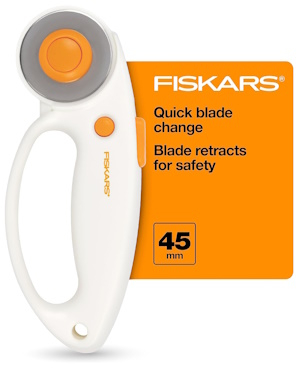
Fiskars Comfort Loop Rotary Cutter
Check Price1. Rotary Cutter with Self-Healing Mat
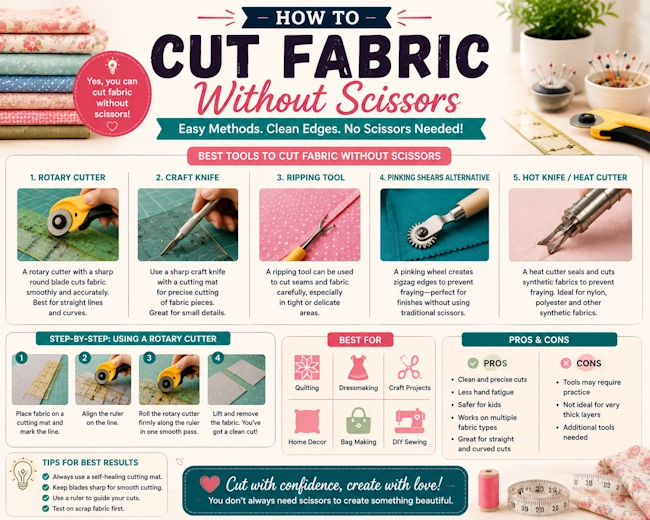
The rotary cutter is the most popular scissors alternative for sewists, originally designed for quilters cutting straight strips of fabric. It consists of a circular blade mounted on a handle, used with a self-healing cutting mat (to protect your work surface) and a clear acrylic ruler to guide straight cuts. Blade sizes range from 18mm (for small curves) to 60mm (for thick fabrics like denim and canvas). To use: place your fabric flat on the mat, layer with a ruler along your cut line, and roll the cutter along the ruler edge with firm, even pressure. Always retract the blade when not in use to avoid injuries.
- Best for: Woven fabrics including quilting cotton, linen, canvas, denim, and fleece. Works for straight cuts and gentle curves.
- Pros: Extremely straight cuts, less hand fatigue than scissors, cuts up to 4 layers of fabric at once, replaceable blades stay sharp.
- Cons: Requires a self-healing mat and ruler, sharp blades pose safety risks, not ideal for tight curves or very delicate fabrics like chiffon.
2. Tearing Along the Straight Grain
This is the oldest scissors-free cutting method, and it’s still useful for quick, straight cuts on woven fabrics. Woven fabric has a straight grain (parallel to the selvage, the finished edge of the fabric) and a cross grain (perpendicular to the selvage). Tearing only works along the straight grain. To use: make a small 1/4-inch snip at the edge of the fabric along the straight grain, then grip both sides of the snip and pull firmly in opposite directions. The fabric will tear in a straight line parallel to the selvage.
- Best for: Medium-weight woven fabrics like cotton, linen, canvas, and denim. Ideal for cutting straight garment pieces or quilting squares.
- Pros: Free, super fast, guaranteed straight edge, no tools required.
- Cons: Only works for straight cuts along the straight grain, damages delicate fabrics, does not work for knits, stretch fabrics, or bias cuts.
3. Hot Knife for Synthetics
A hot knife is a heated blade tool, often used for crafting with plastic, that works perfectly for cutting synthetic fabrics like polyester, nylon, and spandex. The heat melts the synthetic fibers as it cuts, sealing the edge immediately to prevent fraying. To use: plug in the hot knife and let it heat up for 2-3 minutes, then drag the blade along a ruler or cut line with steady pressure. Avoid holding the blade in one spot too long, as this can burn or discolor the fabric. Always work in a well-ventilated area, as melting synthetics release fumes.
- Best for: Synthetic woven and knit fabrics including polyester, nylon, spandex, and ripple foam. Ideal for activewear, outdoor gear, and banner fabric.
- Pros: Seals edges to eliminate fraying, clean cuts, no snagging on synthetic fibers.
- Cons: Only works for synthetic fabrics (will not cut cotton, linen, or silk), releases fumes, fire hazard, not for tight curves.
4. Serger/Overlocker
A serger (also called an overlocker) is a specialty sewing machine that trims fabric edges and finishes seams with overlock stitches in one step. Most sergers have a built-in blade that cuts the fabric as you guide it through, making it a great scissors-free option for finishing edges. To use: set up your serger with the correct thread and stitch type for your fabric, then guide the raw edge of your fabric under the presser foot. The blade will trim the edge to the exact width of your overlock stitch. Note that sergers are not designed for cutting out full garment pieces, only for trimming and finishing edges.
- Best for: Knit fabrics, woven fabrics for seam finishing, hems, and edge trimming. Not for cutting full pattern pieces.
- Pros: Cuts and finishes edges in one step, eliminates fraying, fast for bulk projects.
- Cons: Requires a serger, only cuts narrow edges, not for cutting out full pattern pieces or curves.
5. Sewing Machine Perforation
Your regular sewing machine can double as a cutting tool with this method, which is ideal for delicate fabrics that snag with blades. Set your machine to a long straight stitch (stitch length 4-5) and sew along your cut line without backstitching. The long stitches will perforate the fabric, making it easy to tear along the line for a clean edge. For extra precision, you can sew two parallel lines of perforation. This method works best for straight and gentle curved cuts.
- Best for: Delicate woven fabrics like silk, chiffon, satin, and lace. Ideal for cutting out garment pieces without snagging.
- Pros: No extra tools required, gentle on delicate fibers, very precise, works for curves.
- Cons: Slow for large projects, leaves small perforation holes in the fabric, not for thick fabrics like denim.
6. Home Laser Cutter
Small desktop laser cutters (like the Glowforge or xTool) have become more affordable for home sewists, and they deliver unmatched precision for intricate cuts. You upload your pattern to the cutter’s software, adjust the power and speed settings for your fabric type, and the laser cuts the shape exactly. For synthetic fabrics, the laser seals edges just like a hot knife. For natural fibers, it leaves a clean, charred edge that does not fray.
- Best for: Intricate appliques, small pattern pieces, synthetic fabrics, and natural fibers for projects like quilting, embroidery, and garment accents.
- Pros: 100% precise, cuts any shape including tight curves and intricate details, seals edges for synthetics.
- Cons: Expensive upfront cost, slow for cutting large pieces of fabric, requires ventilation for fumes.
7. Snap-Off Utility Knife
A standard snap-off utility knife (the kind used for box cutting) works as a budget-friendly rotary cutter alternative. These knives have blades with scored sections that snap off to reveal a fresh sharp edge when dull. Use a 18mm or 25mm blade with a self-healing mat and acrylic ruler, just like a rotary cutter. Drag the blade along the ruler with firm pressure to cut through fabric. Replace the blade section as soon as it feels dull to avoid snagging.
- Best for: Thick, heavy fabrics like denim, canvas, leather, and upholstery fabric. Ideal for straight cuts.
- Pros: Very affordable, replaceable blades stay sharp, cuts through multiple thick layers.
- Cons: Not for curves or delicate fabrics, requires mat and ruler, sharp blade safety risk.
Tips for Cutting Fabric Without Scissors
Follow these expert tips to get the best results with any scissors-free cutting method:
- Always test your cutting method on a scrap piece of your project fabric first to check for snagging, melting, or uneven cuts.
- Use pattern weights instead of pins to hold patterns in place for delicate fabrics like silk or chiffon, which snag easily from pin holes.
- Replace rotary cutter, utility knife, or hot knife blades as soon as they feel dull to avoid pulling fibers or leaving jagged edges.
- Work on a flat, stable table to ensure straight cuts, especially when using rulers or mats.
- For thick fabrics like denim, cut one layer at a time if your tool struggles with multiple layers.
- Store all sharp cutting tools (rotary cutters, hot knives, utility knives) in a locked drawer or high shelf away from children and pets.
Frequently Asked Questions
Can I cut all fabrics without scissors?
No, not every method works for every fabric. For example, hot knives only work for synthetics, tearing only works for woven fabrics along the straight grain, and sewing machine perforation is too delicate for thick denim. Always match your cutting method to your fabric type, and test on scrap first.
Will cutting fabric without scissors prevent fraying?
Some methods will, some won’t. Hot knives and laser cutters seal synthetic edges to eliminate fraying entirely. Sergers finish edges to prevent fraying. Rotary cutters, tearing, and utility knives leave raw edges that will fray just like scissor cuts, so you’ll still need to finish seams.
Is a rotary cutter better than scissors for cutting fabric?
For straight cuts, multiple layers, and thick fabrics, yes. Rotary cutters deliver straighter lines with less hand fatigue. For tight curves, delicate fabrics like chiffon, or small projects, scissors (or sewing machine perforation) may be better. It depends on your project and fabric.
Can I use a regular kitchen knife to cut fabric?
We don’t recommend it. Kitchen knives are not designed for fabric, so they will snag fibers, leave jagged edges, and dull quickly. They also pose a higher safety risk than purpose-made tools like rotary cutters or utility knives. Stick to sewing-specific cutting tools for best results.
Conclusion
Learning how to cut fabric without scissors opens up new options for your sewing projects, especially when working with tricky fabrics or dealing with dull tools. Start with the method that matches your most common fabric types: rotary cutters for quilting and wovens, sewing machine perforation for delicate silks, and hot knives for synthetics. Always test first, prioritize safety with sharp tools, and don’t be afraid to experiment to find your favorite scissors-free workflow. With these methods, you’ll never be stuck mid-project without a working pair of shears again.
