
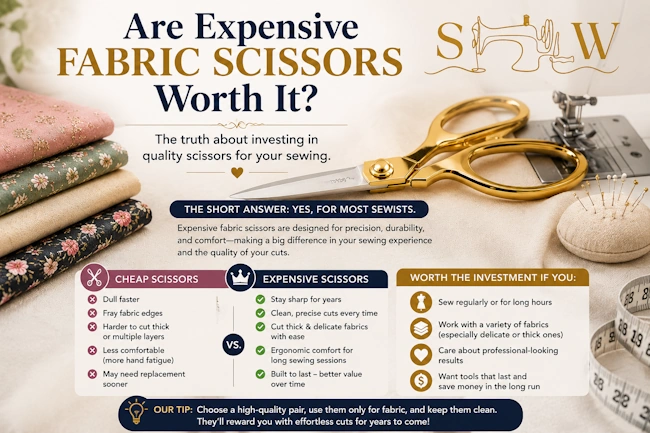
If you’ve ever stood in the craft store aisle staring at an $80 pair of fabric shears next to a $10 multipack, you’ve probably asked yourself: Are expensive fabric scissors worth it? It’s a fair question, especially if you’re just starting out sewing or quilting and don’t want to blow your budget on tools you might not use often. But as someone who’s spent over a decade sewing everything from delicate silk to heavy denim, I can tell you the answer isn’t a simple yes or no, it depends entirely on how you sew, what fabrics you work with, and how much you value your time and finished projects. Below, we’ll break down the real differences between budget and premium shears, who should invest, who can save, and how to make any pair last longer.

Fiskars 8″ Original Orange-Handled Stainless Steel Scissors, Ergonomic and Keeps Material Flat, Sharp All-Purpose Paper and Fabric Scissors for Office, Arts, and Crafts
Check PriceWhat Makes Expensive Fabric Scissors Different?
Blade Material and Construction
Most budget fabric scissors use low-grade stainless steel, or even carbon steel coated in plastic, that dulls quickly after cutting through even medium-weight cotton. Premium shears, by contrast, use high-carbon stainless steel, Japanese cutlery steel, or even cobalt-infused blades that are heat-treated to stay sharp for years. Independent sewing tool testing confirms that premium shears hold their edge 3-5x longer than budget pairs, even with daily use. They also feature precision-ground blades that meet flush along the entire edge, so they cut cleanly through fabric without snagging or leaving jagged edges.
Cheap scissors often have blades that are stamped from sheet metal, leaving tiny imperfections along the cutting edge that catch on fibers. Expensive shears are forged or milled, creating a smooth, consistent edge that glides through fabric with minimal pressure. For context: I’ve had a pair of German-made forged shears for 8 years, and I only sharpen them once every 18 months, even though I cut denim, canvas, and wool weekly.
Ergonomic Design
Budget scissors almost always use generic, symmetrical handles that force you to twist your wrist to cut. Premium shears are designed with ergonomics in mind: offset handles that keep your wrist straight, padded grips to reduce hand fatigue, and finger rests that distribute pressure evenly. If you’ve ever finished a sewing session with a cramped hand or sore wrist, you know how much of a difference this makes. For professional dressmakers or quilters who cut fabric for 4+ hours a day, ergonomic design isn’t a luxury; it’s a necessity to avoid repetitive strain injuries.
Many high-end shears also come in left-handed and right-handed models, unlike budget multipacks that are almost exclusively right-handed. Left-handed sewers often struggle with cheap scissors that push fabric up instead of down, leading to uneven cuts. Premium brands cater to all users, which is a small but meaningful difference for left-handed makers.
Warranty and Durability
Budget scissors are disposable: once they dull, you throw them away, because sharpening costs almost as much as buying a new pair. Expensive shears almost always come with lifetime or 10-year warranties that cover free sharpening, blade replacement, or full refunds if the scissors break under normal use. Brands like Gingher and Kai, for example, will sharpen their shears for free for the life of the product, as long as you pay shipping. Over 5-10 years, that makes premium shears far cheaper than replacing $10 pairs every 6 months.
When Expensive Fabric Scissors Are 100% Worth It
Not every sewer needs to drop $100 on shears, but there are clear use cases where premium scissors will save you time, money, and frustration in the long run. Let’s break down the most common scenarios:
You Sew Delicate or Slippery Fabrics Regularly
Silk, chiffon, satin, and lace are notorious for snagging on dull or imperfect blades. A cheap pair of scissors will catch on the fibers of these fabrics, leaving pulls or tears that ruin your project. Premium shears with polished, sharp blades glide through slippery fabrics without shifting or snagging, which is critical for formalwear, lingerie, or heirloom sewing. If you’re working with expensive fabrics (silk can cost $30+ per yard), an $80 pair of scissors is a tiny investment to protect your materials.
Proper cutting technique matters too; brush up on how to cut fabric without fraying or distorting to get the most out of your shears, no matter their price point.
You Cut Heavyweight Materials Like Denim or Leather
Budget scissors will bend or chip if you try to cut through 12oz denim, canvas, or leather. Premium shears are built with thicker, stronger blades that can handle heavyweight materials without warping. I’ve seen cheap scissors break in half mid-cut when going through multiple layers of denim, which is not only frustrating, but it’s dangerous, as broken metal can fly into your fabric or skin. If you sew jeans, bags, or upholstery, premium shears are non-negotiable.
You Sew for Long Sessions
As mentioned earlier, ergonomic design makes a massive difference for sewers who spend hours at their cutting table. Premium shears require far less hand strength to cut through fabric, so you won’t end up with cramping or tendonitis after a long day of sewing. For hobbyists who sew every weekend, or professionals who sew for a living, this comfort is worth every penny.
When You Can Skip the Premium Price Tag

Professional 9 Inch Sewing Scissors for Fabric Cutting – Ultra Sharp, Heavy Duty Fabric Shears for Smooth, Precise Cuts on All Fabrics and Leather, for Tailors, Dressmakers, Crafters, and Artists
Check PriceThere are plenty of scenarios where a $10 pair of fabric scissors will work just fine, and you don’t need to feel guilty for saving your money. Here are the most common cases:
You Only Sew Occasionally
If you sew once every few months to hem a pair of pants or fix a torn shirt, you won’t put enough wear on your scissors to justify the premium price. A budget pair will last you years with occasional use, and you can always upgrade later if you start sewing more often. No need to spend $80 on a tool you’ll use twice a year.
You Work Exclusively with Sturdy, Non-Slip Fabrics
Quilting cotton, linen, and flannel are sturdy and easy to cut, even with dull blades. If you only sew quilts or simple cotton garments, a budget pair will handle these fabrics without issue. You won’t notice the difference in cut quality that you would with delicate or heavy fabrics.
You’re on a Tight Beginner Budget
Starting sewing can be expensive: you need a machine, thread, fabric, patterns, and notions. If you’re just testing the waters to see if you like sewing, a budget pair of scissors is a smart way to save money. You can always buy premium shears later once you’re sure you’ll stick with the hobby. I always recommend beginners spend their money on a good sewing machine first, then upgrade tools as they go.
Budget vs Premium Scissors: Side-by-Side Comparison

Gingher 8″ Dressmaker’s Fabric Scissors, Stainless Steel Shears, Sharp Knife Edge Steel Sewing Shears with Protective Sheath for Fabric Cutting and Tailoring, Chrome Plated Nickel Finish
Check PriceTo make the differences clear, here’s a quick breakdown of how budget and premium shears stack up across key categories:
- Blade Material: Budget = low-grade stainless steel; Premium = high-carbon, forged steel
- Edge Retention: Budget = dulls after 10-20 hours of use; Premium = stays sharp for 100+ hours
- Ergonomics: Budget = generic, symmetrical handles; Premium = offset, padded, left/right-handed options
- Warranty: Budget = none; Premium = lifetime or 10-year coverage with free sharpening
- Best For: Budget = occasional sewers, sturdy fabrics; Premium = daily sewers, delicate/heavy fabrics
Expert Tips to Make Any Fabric Scissors Last Longer

Fabric Scissors Tailor Sewing Shears – 9 Inch Heady Duty Scissors for Fabric Cutting Professional Ultra Sharp Cloth Tailor Scissors Multipurpose Utility Dressmaker Leather Titanium Scissors (9Inch)
Check PriceWhether you buy a $10 pair or a $100 pair, proper care will extend their life significantly. Follow these simple rules:
- Never use fabric scissors to cut paper, plastic, or hair; this dulls blades instantly.
- Store scissors in a protective sheath or case when not in use to avoid nicks.
- Wipe blades clean with a dry cloth after every use to remove fabric fibers and oil.
- Only sharpen scissors when they start to snag, and use a professional sharpener (not a home sharpening tool) for premium shears.
If you’re ready to invest in a pair that will last decades, check out our roundup of top-rated fabric scissors for every skill level and budget. We tested 20+ pairs across price points to find the best options for every type of sewer.
Frequently Asked Questions
Can I use expensive fabric scissors for paper?
Absolutely not. Paper contains abrasive minerals that will dull your fabric scissors instantly, even if they’re premium forged steel. Keep a separate cheap pair of scissors for paper, and label your fabric shears clearly to avoid mix-ups. I’ve seen sewers ruin $100 shears in one afternoon by cutting pattern paper with them — don’t make that mistake.
How much should I spend on a good pair of fabric scissors?
For a pair that will last 5+ years with regular use, expect to spend $40-$80. Pairs under $30 are usually budget quality, while pairs over $100 are often specialty shears for industrial use. For most hobbyists, $50-$60 will get you a high-quality pair with a solid warranty and ergonomic design.
Do I need separate scissors for different fabrics?
You don’t need separate scissors, but it’s a good idea to have a small pair of embroidery scissors for delicate work and a large pair of shears for cutting out patterns. If you work with both delicate silk and heavy denim, you may want two pairs to avoid transferring fibers or dulling blades on heavy materials. That said, one high-quality pair of 8-inch shears will handle almost all home sewing projects.
Conclusion: Are Expensive Fabric Scissors Worth It
So, are expensive fabric scissors worth it? For daily sewers, professionals, and anyone working with delicate or heavy fabrics: yes, absolutely. The better cut quality, longer lifespan, and ergonomic comfort will save you time and money in the long run, and protect your expensive fabrics from damage. For occasional sewers, beginners on a budget, or those working only with sturdy cotton: a budget pair will work just fine, and you can upgrade later as your skills and sewing time grow.
Remember: no matter what pair you buy, never cut paper with them, store them safely, and sharpen them regularly. And if you’re ready to shop, don’t forget to check our guide to the best fabric scissors, plus our tutorial on proper cutting techniques to get the most out of your new shears. Happy sewing!
