
Finding the best sewing seam gauge is important for anyone who wants clean stitching, even hems, and accurate seam allowances. A seam gauge may look small, but it plays a big role in professional looking results. Whether you are a beginner learning basic sewing or someone experienced in quilting and garment making, the right seam gauge saves time and prevents costly fabric mistakes. In this article, you will find detailed, experience based reviews of the best sewing seam gauges available, along with clear guidance on choosing the right one for your needs.
How to Choose the Best Sewing Seam Gauge
When choosing a seam gauge, material quality matters. Metal gauges usually last longer and keep their shape better than plastic ones. Clear and readable markings are also important, especially if you work in low light. A smooth, stay-in-place sliding mechanism is another key feature. Some seam gauges include extra tools like seam rippers or multi measurement markings, which can be useful for daily sewing tasks.
1. Sewing Measuring T Shaped Sliding Quilting Gauge
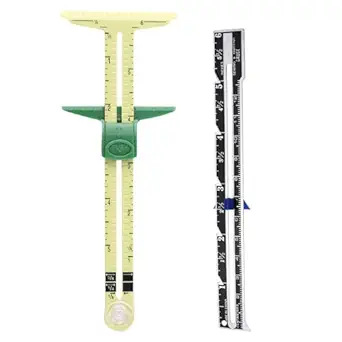
The Sewing Measuring T Shaped Sliding Quilting Gauge is a versatile tool designed to help sewists achieve precise measurements. Its T shaped design makes it more stable across fabric edges compared to a flat ruler. The sliding marker allows you to set a measurement and keep it fixed while running the gauge along seams, hems, or quilt lines. This stability is especially helpful when you need consistent results across multiple pieces.
In everyday use, this gauge is suitable for measuring seam allowances, hems, pleats, and spacing lines on quilting projects. The markings are clear and easy to read, even in dim light, which prevents misreading measurements. Fabric edges line up well against the flat base of the T shape, making it easier to keep measurements straight without tilting the tool. The sliding marker feels smooth yet firm once set, which prevents accidental movement while working.
Beginners will find the gauge easy to handle because of its straightforward design. Experienced sewists can appreciate the accuracy it brings, especially when working on tailored garments or quilting patterns that require uniform seam allowances. The gauge is made of durable material that holds up well under regular use, though it is not a heavy industrial tool.
One point to note is that the gauge’s length limits it to short measurements, but that’s expected for this type of tool. For longer measurements, a tape measure or longer ruler would complement this gauge.
Pros
- T shaped design offers stable alignment on fabric
- Clear and easy to read markings
- Smooth sliding marker that stays in place
Cons
- Limited length for short measurements
- Not intended for very heavy professional use
Best Uses
- Seam allowances and hem measuring
- Quilting line spacing
- Precision tasks on garments
2. Sewing Gauge Measuring Sliding Ruler
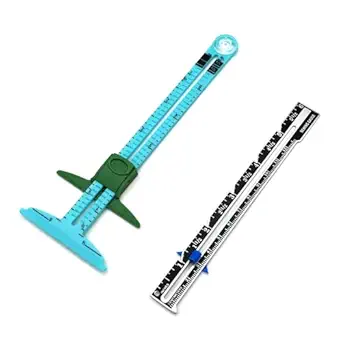
The Sewing Gauge Measuring Sliding Ruler is a straightforward tool that focuses on delivering accurate, repeatable measurements without complicated features. If you are someone who prefers simplicity and reliability over bulkier multi-purpose tools, this gauge fits naturally into your sewing kit. Its sliding marker lets you lock in a measurement so you can quickly transfer it across fabric edges, ensuring consistent hems, seam allowances, or button placements.
When using this gauge, the first thing you’ll notice is how intuitive it is to handle. The lightweight plastic feels comfortable in hand, yet the structure is sturdy enough to avoid unwanted flexing during measurement. The printed numbers and marking lines are clear and easy to read, making it suitable even under low lighting or when you’re in a hurry. Beginners especially appreciate not having to guess which lines represent fractions; the markings are spaced logically for fast interpretation.
In daily sewing tasks, this gauge works well for men’s and women’s garment alterations, home decor stitching, and quilting edge spacing. It doesn’t replace a tape measure for long distances, but for short, precise measurements it delivers consistent results. The slider stays reliably in place once set, which reduces the need to re-measure multiple times.
The simplicity of this tool is its strength. It is a good option for anyone who needs dependable small measurements without paying extra for advanced features they won’t use. That said, this gauge may feel too basic if you are looking for a multi-feature tool that doubles as a seam finder, angle measure, or cutter guide.
Pros
- Easy to read and use immediately
- Lightweight and beginner-friendly
- Reliable sliding marker mechanism
Cons
- Not ideal for advanced specialty tasks
- Plastic build may wear over time
Best Uses
- Seam allowance measuring
- Button placement and hem checks
- Basic sewing and quilting edge spacing
3. LINXIAO Sewing Measuring T Shaped Sliding Quilting Gauge (Alternate Version)
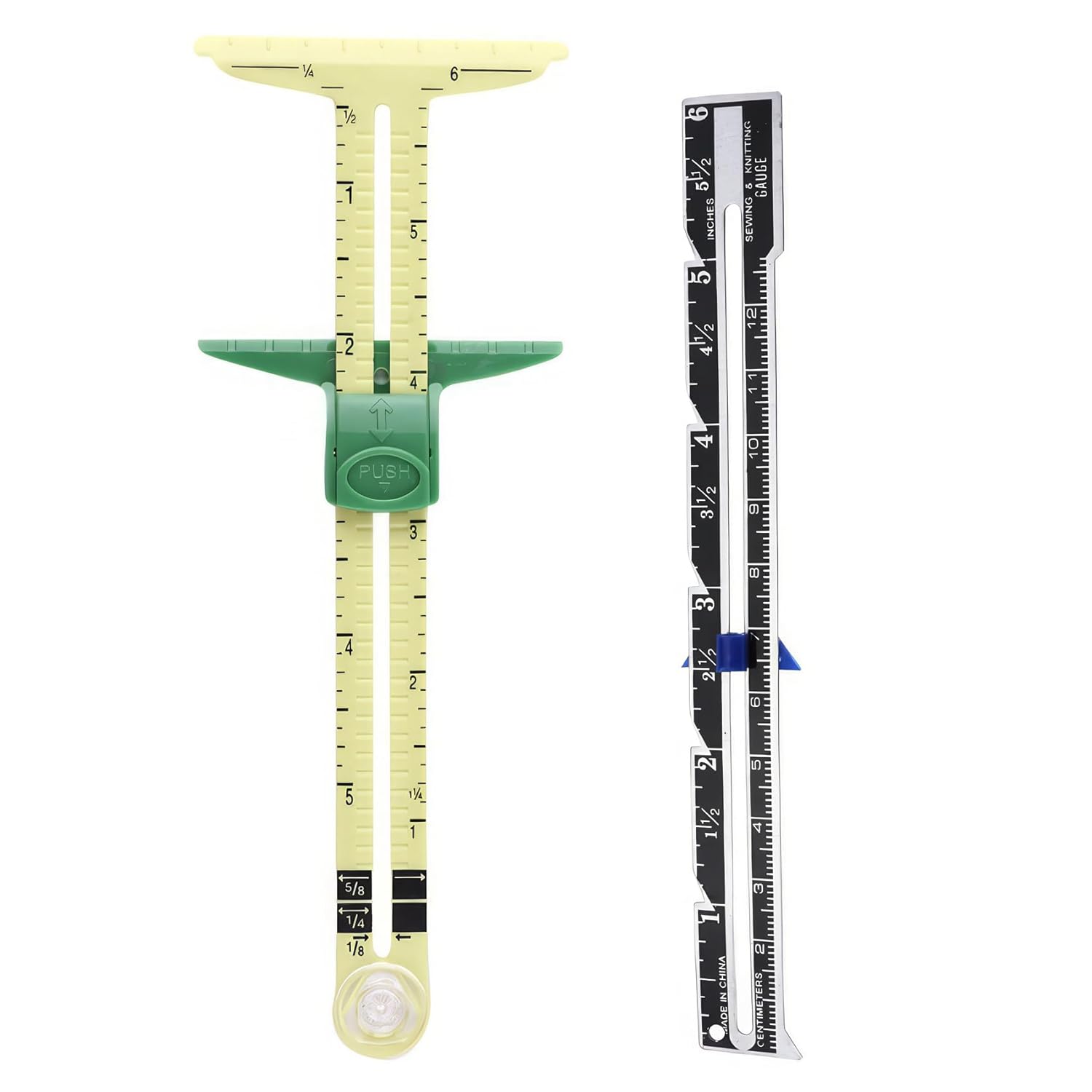
The Sewing Measuring T Shaped Sliding Quilting Gauge (alternate version) is another thoughtful take on a classic seam gauge design. Just like other T shaped tools, it provides a firm edge that helps you align fabric accurately. The sliding marker is easy to adjust, and once set, it stays in place without drifting. This makes it easier to repeat the same measurement multiple times without re-measuring from scratch.
In practical use, this gauge shines when you need precise seam allowances, uniform hems, and consistent spacing for quilting lines. The T shape gives you stability along straight fabric edges, so you don’t find yourself twisting or guessing distances. The printed markings are crisp and clear, which is important when you’re working with fine lines or slow stitching tasks. Even in softer or slippery fabric, the gauge stays reasonably firm as you move it along the textile surface.
This version isn’t meant for measuring longer distances; for that, a longer ruler or tape measure should be used alongside it. Still, for most sewing and quilting tasks that involve short, precise measurements, it performs reliably and consistently.
Pros
- Stable and easy to align on fabric edges
- Smooth slider that holds measurement securely
- Clear printed markings
Cons
- Limited to short measuring distances
- Not heavy duty for industrial use
Best Uses
- Seam allowance checks
- Quilting line spacing
- Hem measurements and button placement
4. Measuring Tool for Knitting Crafting and Beginner Quilting
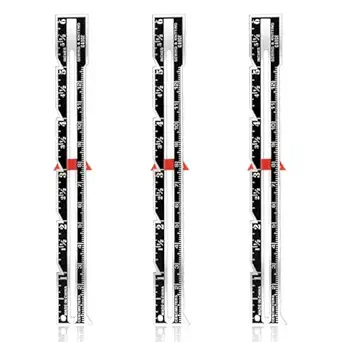
This measuring tool is designed for people who work across different crafts, not just sewing. It suits beginners who are learning quilting, knitting, and basic stitching and want one simple tool that covers short measurements accurately. The design is straightforward, which helps new users avoid confusion while measuring seams or spacing stitches.
In real use, this tool works well for checking seam allowances, marking small fabric distances, and aligning edges during quilting. The markings are clear enough for everyday use, and the tool feels light in the hand. Because it is not bulky, it fits easily into small sewing kits or craft bags. Beginners often appreciate tools like this because they do not feel intimidating or overly technical.
This measuring tool is best used for light and medium crafting tasks. It may not offer the durability or weight that advanced sewists prefer, but it performs consistently for hobby level projects. If you mainly work on small sewing projects, handmade gifts, or practice pieces, this tool offers good value.
Pros
- Beginner friendly design
- Lightweight and easy to carry
- Suitable for multiple crafts
Cons
- Not ideal for heavy daily sewing
- Limited advanced features
Best Uses
- Beginner quilting projects
- Knitting and crafting measurements
- Basic seam allowance checks
5. Swpeet Professional Seam Ripper and Gauge Assortment
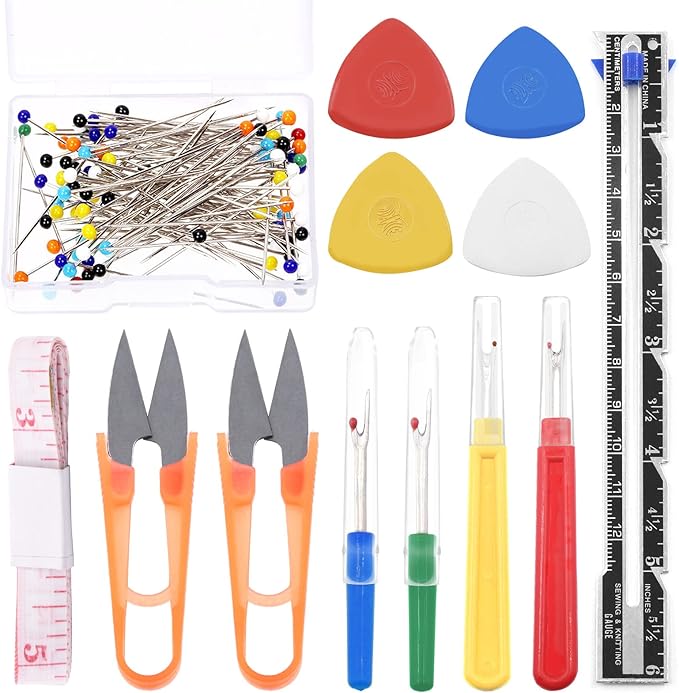
This product stands out because it combines seam gauges with seam rippers in one practical set. It is designed for sewists who frequently adjust, correct, or redo stitching. Having both tools together saves time and keeps essential items within reach.
The seam gauge in this set provides accurate short measurements for hems, pleats, and seam allowances. The seam rippers are sharp and effective, allowing clean thread removal without damaging fabric. This combination is especially useful when working on garments that require frequent fitting adjustments.
In daily use, this set feels practical rather than decorative. It is ideal for sewing rooms where functionality matters more than appearance. The tools feel solid and dependable for regular sewing tasks. While beginners can use it, this set is particularly helpful for people who already sew regularly and understand the value of quick corrections.
Pros
- Includes multiple useful tools
- Sharp and effective seam rippers
- Good value for frequent sewing
Cons
- May feel unnecessary for casual users
- Slightly bulkier than single tools
Best Uses
- Garment alterations
- Stitch corrections
- Daily sewing and tailoring
6. Fiskars 132050 1001 Measuring Gauge
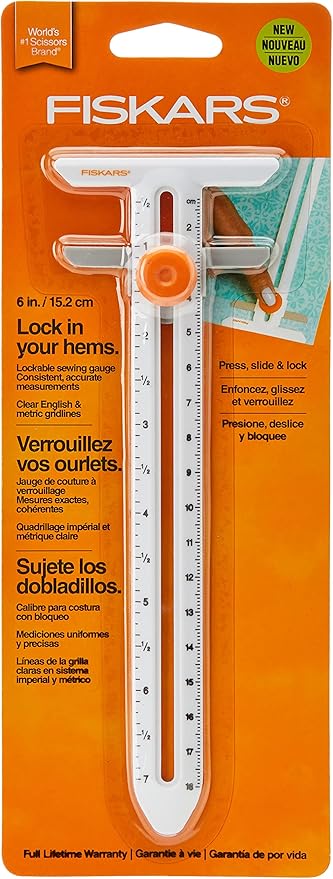
Fiskars is known for producing reliable crafting tools, and this measuring gauge reflects that reputation. The build quality feels strong, and the bright orange color makes it easy to locate on a busy sewing table. The markings are clean and precise, which helps reduce reading errors.
In practical sewing, this gauge performs very well for seam allowances, hems, and spacing tasks. The sliding marker holds firmly once set, allowing you to repeat measurements confidently. It feels balanced in the hand and does not bend easily, even with repeated use.
This gauge is suitable for both beginners and experienced sewists. While it is slightly more expensive than generic options, the durability justifies the price for people who sew regularly.
Pros
- Durable and well built
- Highly visible color
- Accurate and stable slider
Cons
- Higher price than basic gauges
- Limited to short measurements
Best Uses
- Frequent sewing projects
- Professional looking hems
- Consistent seam spacing
7. Measuring T Shaped Quilting Knitting and Crafting Tool
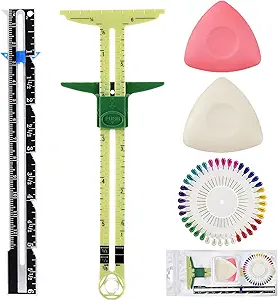
This T shaped measuring tool is designed for users who want straight alignment and accuracy across fabric edges. The shape helps keep measurements square, which is especially useful for quilting and garment construction.
In use, the gauge feels steady and predictable. The sliding component allows quick adjustments, and the markings are easy to follow. It works well on cotton, denim, and quilting fabrics where clean edges matter.
This tool fits well into both beginner and intermediate sewing setups. It does not try to replace larger rulers but complements them by handling precision tasks efficiently.
Pros
- Stable T shaped design
- Clear markings
- Good control on fabric edges
Cons
- Short measuring range
- Not designed for long measurements
Best Uses
- Quilting alignment
- Seam allowance checks
- Craft fabric spacing
8. Sewing Gauge Measuring Sliding Ruler (Model B0FRML7RH7)
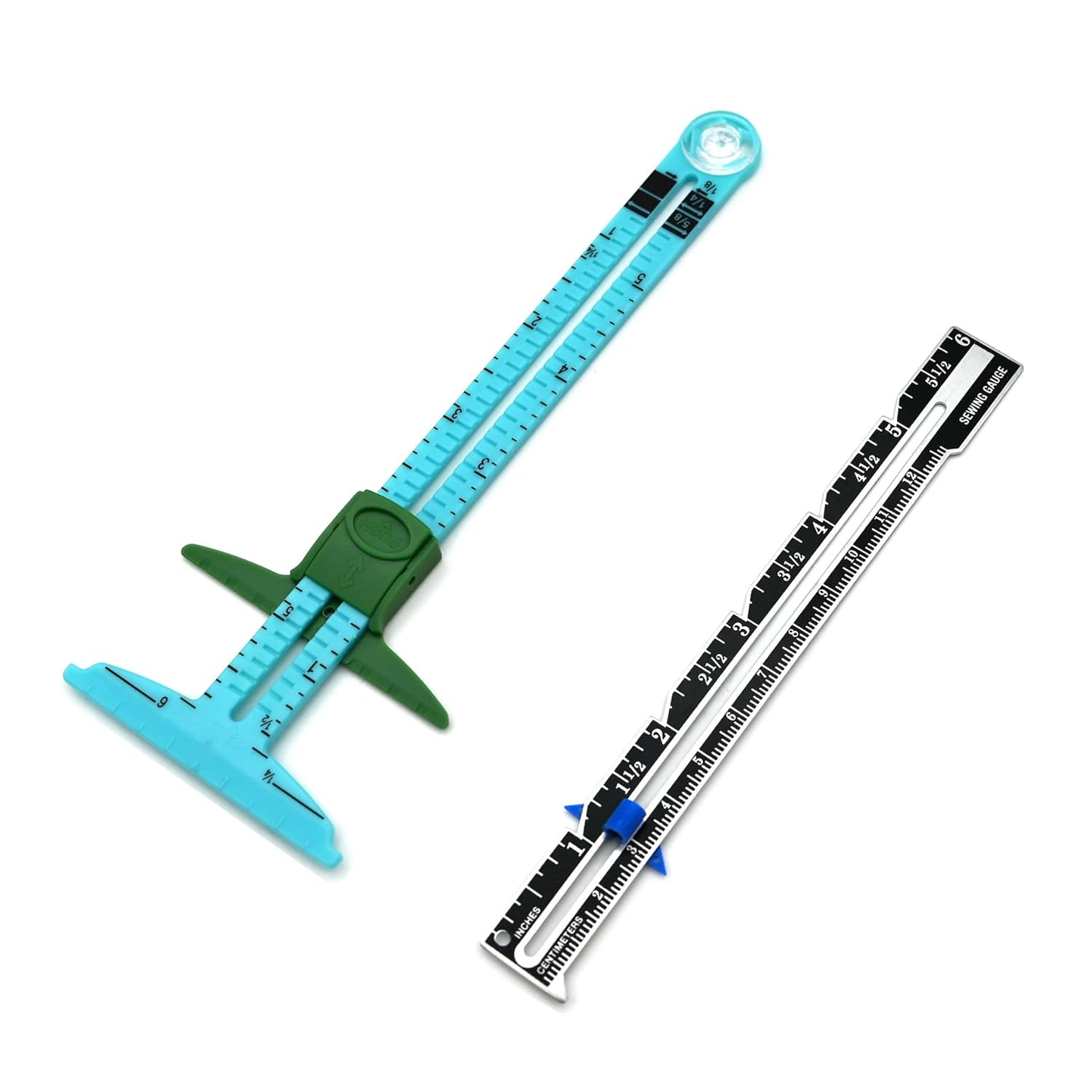
The Sewing Gauge Measuring Sliding Ruler with the sliding marker mechanism is a compact and dependable tool for anyone who wants precise short-distance measurements in sewing. This gauge is designed to help sewists handle tasks where accuracy matters such as checking seam allowances, confirming hems, and spacing out buttonholes. The sliding piece locks measurements in place once set, so you can move the ruler along fabric edges without losing your reference point.
In actual use, this gauge stands out because it combines simplicity with reliability. The plastic body feels sturdy enough to hold up under regular light to medium sewing tasks, yet it remains light in weight, so it doesn’t add bulk to your sewing kit. The printed markings are clear and evenly spaced, making it easy to read inches and fractions without second guessing. This clarity is particularly useful for beginners who are still learning how to interpret small measurements accurately.
The sliding mechanism works smoothly and stays firmly set once adjusted. This means you can set a measurement and repeat it across several pieces of fabric without needing constant re-checking. Users who do quilting, dress alterations, or even home decor sewing projects will find this tool quite handy for daily short measurement needs.
While this model isn’t designed for heavy industrial use, it performs consistently for everyday sewing and crafting. It doesn’t try to be a multi-purpose instrument, which actually works in its favor for anyone who just needs a reliable seam gauge.
Pros
- Clear, easy-to-read markings
- Smooth sliding marker with stable hold
- Lightweight and portable
Cons
- Plastic body may wear over long years
- Limited measurement length
Best Uses
- Seam allowance checks
- Button spacing and hem alignments
- Everyday sewing and craft projects
9. Dritz 620 Sewing Gauge
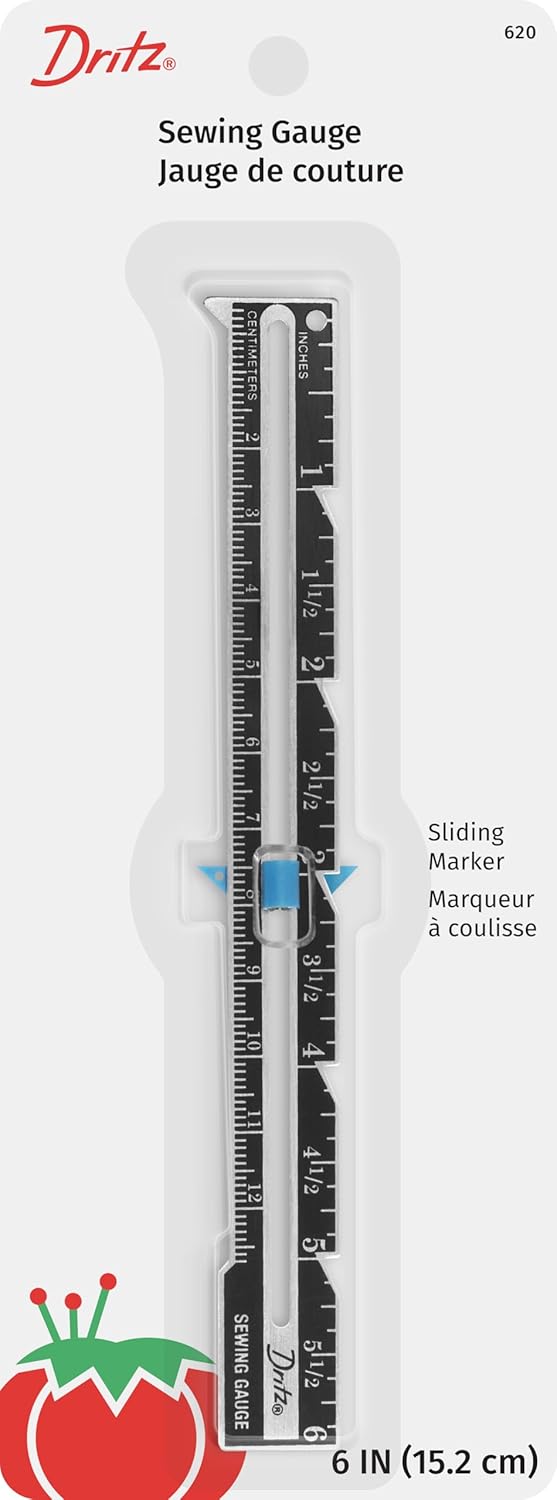
The Dritz 620 Sewing Gauge is a trusted classic in the world of sewing tools. It comes with a metal build that feels solid and durable, and traditional markings that long-time sewists swear by. This gauge isn’t flashy, but what it lacks in bells and whistles it makes up for in dependable, no-nonsense performance. The sliding marker on this model is simple yet effective. It lets you lock in a measurement and repeat it clearly across your fabric pieces.
In everyday sewing work, this gauge delivers accurate results because its metal construction doesn’t bend easily. This is an advantage when handling heavier fabrics like denim, canvas, or upholstery materials. The printed measurements are easy to read, and the sliding marker moves with just enough resistance so it doesn’t shift accidentally. Because of its solid build, this gauge tends to give consistent results over long-term use.
Beginners can benefit from this gauge’s straightforward design. There’s no confusing layout or extra tools attached, what you see is a straightforward measuring device that does what it promises. Experienced sewists appreciate how it feels in hand and how it maintains accuracy even after repeated use. It is a tool that feels reliable and stands up well alongside other sewing instruments in your kit.
While it may not be as lightweight as plastic gauges, the trade-off in durability makes it a worthwhile addition for people who sew regularly or work with challenging fabrics.
Pros
- Durable metal construction
- Trusted traditional design
- Stable sliding mechanism
Cons
- Slightly heavier than plastic gauges
- Limited measuring range
Best Uses
- Frequent and regular sewing
- Heavy fabric measurement
- Precise seam allowances
How to Use a Sewing Seam Gauge Correctly
Using a sewing seam gauge correctly can improve accuracy and save a lot of time during sewing. Many beginners own a seam gauge but do not use it to its full potential. Once you understand the correct method, this small tool becomes one of the most useful items in your sewing kit.
Setting the Measurement
Start by deciding what measurement you need, such as a seam allowance, hem width, or button spacing. Slide the marker on the seam gauge until it lines up with the desired measurement mark. Make sure the marker is pressed firmly so it does not move while working. This locked measurement allows you to repeat the same distance accurately across fabric.
Measuring Seam Allowances
Place the flat edge of the seam gauge against the raw edge of the fabric. The sliding marker will show the exact seam allowance distance. As you move along the fabric edge, keep the gauge straight and steady. This method helps maintain consistent seam widths, especially useful for garment construction and quilting.
Checking and Marking Hems
To measure a hem, set the gauge to the desired hem depth. Align the base of the gauge with the fabric edge and use tailor’s chalk or a fabric marker to mark the fold line. Repeat this process around the garment. This ensures an even hem all the way around without constantly re-measuring.
Button and Pleat Spacing
Seam gauges are excellent for spacing buttons and pleats evenly. After setting the distance, place the gauge between marks and transfer the measurement directly onto the fabric. This avoids uneven spacing, which is a common mistake when measuring by eye.
Quilting and Craft Use
For quilting, a seam gauge helps maintain uniform seam allowances and spacing between quilt lines. When working on crafts or home decor projects, it ensures symmetry and neat finishing. The T-shaped seam gauges are especially helpful for keeping measurements square.
Common Usage Tips
Always keep the gauge clean so markings remain visible. Avoid forcing the sliding marker, as this can loosen it over time. Pair your seam gauge with a tape measure for longer measurements, using each tool where it performs best.
Comparison Table: Best Sewing Seam Gauges
| Product Name | Material | Best For | Skill Level | Standout Feature |
| Sewing Measuring T Shaped Sliding Quilting Gauge B0D2D4XJJZ | Metal | Quilting and garments | Beginner to Advanced | Stable T shape alignment |
| Sewing Gauge Measuring Sliding Ruler B0FRML7RH7 | Plastic | Daily sewing tasks | Beginner | Lightweight and simple |
| T Shaped Sliding Quilting Gauge B0DQJD6Z8Y | Metal | Precision seam work | Intermediate | Firm sliding lock |
| Measuring Tool for Knitting and Crafting B0FX44JKCX | Plastic | Crafting and light sewing | Beginner | Multi craft use |
| Swpeet Seam Ripper and Gauge Set B0BC86XYSZ | Mixed | Alterations and fixes | Intermediate | Combo tool set |
| Fiskars Measuring Gauge B07B6WNWJM | Metal | Regular sewing | Beginner to Advanced | Durable brand quality |
| T Shaped Quilting Crafting Tool B0FBCV8GF7 | Metal | Straight measurements | Intermediate | Strong edge control |
| Sewing Gauge Sliding Ruler B0FRML7RH7 | Plastic | Simple measurements | Beginner | Easy portability |
| Dritz 620 Sewing Gauge | Metal | Professional sewing | Intermediate to Advanced | Long lasting classic |
Frequently Asked Questions About Sewing Seam Gauges
What is a sewing seam gauge?
A sewing seam gauge is a small measuring tool, usually made of metal or plastic, used to measure short distances in sewing. It’s commonly used for checking seam allowances, hems, button spacing, and pleats.
What is the best sewing seam gauge for beginners?
The best sewing seam gauge for beginners is one with clear markings, both inch and centimeter measurements, and an adjustable sliding marker. Simple, easy-to-read designs are ideal for learning.
What sizes do sewing seam gauges come in?
Most sewing seam gauges are 6 inches (15 cm) long, which is perfect for measuring seam allowances and hems. Some extended versions are slightly longer for added versatility.
Why is a sliding marker important on a seam gauge?
A sliding marker allows you to lock in a specific measurement, making it easier to mark repeated seam allowances or hems accurately without re-measuring each time.
Is a metal seam gauge better than a plastic one?
Metal seam gauges are more durable and heat-resistant, making them better for use with irons. Plastic seam gauges are lightweight and budget-friendly but may warp under heat.
Can a sewing seam gauge replace a measuring tape?
No, a seam gauge is designed for short, precise measurements, while a sewing tape measure is better for long or curved measurements like body sizing and fabric length.
How do you use a sewing seam gauge?
To use a seam gauge, slide the marker to your desired measurement, place the gauge along the fabric edge, and mark or fold the fabric according to the set distance.
Is a seam gauge necessary for sewing?
While not required, a seam gauge greatly improves accuracy and consistency. It’s especially useful for hems, pleats, buttonholes, and quilting projects.
What features should I look for in the best sewing seam gauge?
Look for clear etched markings, dual inch and centimeter scales, a smooth-moving sliding marker, and durable material for long-term use.
Final Conclusion
Choosing the best sewing seam gauge depends on how often you sew and the type of projects you work on. A good seam gauge improves accuracy, consistency, and overall finish, whether you are hemming clothes, quilting, or crafting. Metal gauges like the Dritz 620 offer long-term durability, while sliding ruler styles are lightweight and beginner friendly. T-shaped gauges provide extra stability for straight measurements. No matter which one you choose, learning how to use it properly will make your sewing cleaner, faster, and more professional.
