
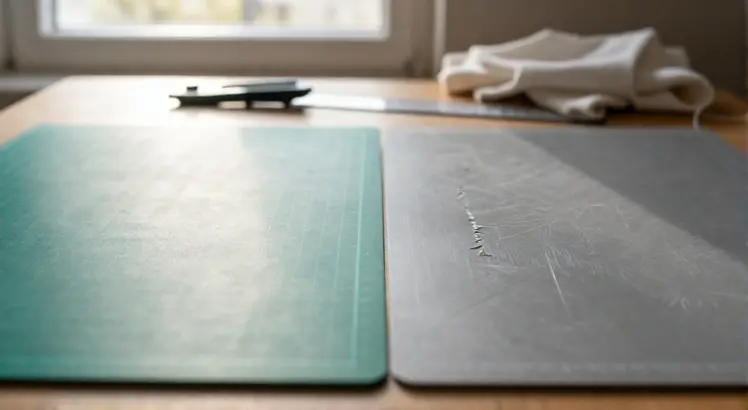
If you’ve spent time around sewing tables or quilting studios, you’ve probably heard the term self-healing tossed around. It sounds almost magical, a mat that repairs itself after every slice of a rotary cutter. But are all cutting mats self healing, or is that just a clever marketing phrase? The short answer is no, not all cutting mats are self-healing, and the difference matters more than you might think. Whether you’re learning how to use a cutting mat for the first time or upgrading your quilting setup, understanding what self-healing really means can save you money, protect your tools, and give you cleaner cuts for years to come.
What Exactly Is a Self‑Healing Cutting Mat?
A self-healing cutting mat is a work surface designed to close up after being cut, so the blade marks don’t turn into permanent grooves. Unlike a piece of cardboard or a sheet of rigid plastic that holds every scratch forever, a true self-healing mat has a unique internal structure. It’s typically made of multiple layers of polyvinyl chloride (PVC) or a similar polymer that can shift and return to its original position after a blade passes through. Imagine cutting into a bundle of soft, tightly packed straws, the straws separate to let the blade in, then slide back together when you pull the blade away. That’s essentially how a self-healing mat works, only on a microscopic scale.
Because the material gives slightly and then reforms, the surface stays smooth much longer, which means your rotary cutter blade doesn’t have to ride over rough, rutted terrain. This extends the life of your blades and helps you get straighter, more precise cuts every time. If you’ve already invested in one of the best rotary cutters for quilting, pairing it with a genuine self‑healing mat is the easiest way to keep that investment sharp.
Are All Cutting Mats Self‑Healing? The Truth Behind the Label
No, all cutting mats are not self-healing. In fact, you can walk into most craft stores and find three distinct categories: self‑healing mats, hard‑surface mats, and mats that claim to be self‑healing but are really just soft PVC with minimal recovery. The confusion often starts because many beginners assume any green or blue mat with grid lines must be self‑healing. That’s simply not the case. The color and the grid are just features; they don’t guarantee the mat will reseal itself after a cut.
Genuine self-healing mats are engineered with a specific blend of materials that have elastic memory. When you run a rotary cutter across them, the blade separates the particles without severing them permanently, and those particles gradually migrate back together. A mat that advertises healing but is made from cheap or thin PVC will show visible cut lines after just a few uses, and those lines will eventually become deep grooves that trap fabric and dull your blades. So while the mat may technically be soft enough to allow a blade to sink in, it doesn’t have the rebound you need for long‑term durability.
How Self‑Healing Mats Actually Work
Inside a quality self-healing cutting mat, tiny particles or fibers are sandwiched between the top and bottom layers. These particles are not chemically bonded in a rigid lattice; instead, they’re held together just enough to form a stable surface but loosely enough to move apart under pressure. When your rotary blade slices down, it pushes the particles aside rather than cutting through them. Once the pressure is removed, the particles slowly shift back, and the surface evens out. This is why you’ll often see a faint silver line left behind after a cut, that’s the mat healing itself. The line fades further over time, especially if you let the mat rest.
The healing ability is not infinite, though. Over years of heavy use, even the best self-healing mats will eventually develop wear. But a high‑quality mat can last a decade or more with proper care, whereas a non‑self‑healing mat may need to be replaced every few months if you use it often. For a deeper dive into keeping your mat in top shape, you can find a detailed explanation from excellent resource on mat maintenance.
The Reality of Non‑Self‑Healing Mats
Non‑self‑healing cutting mats are usually made from hard plastic, high‑density polyethylene, or tempered glass. These surfaces are extremely durable in terms of impact and will never rot or warp as easily as a soft mat, but they do not forgive blade marks. Every cut you make etches a permanent groove into the surface. Over time, those grooves turn the mat into a waffle‑like surface that can skew your ruler, cause your fabric to snag, and rapidly dull your rotary cutter blades. You can think of them like a plastic cutting board in the kitchen: they protect your countertop, but they’ll quickly develop a roadmap of scratches.
This doesn’t mean non‑self‑healing mats are useless. They have their place, especially for crafters who do a lot of non‑cutting work, like gluing, painting, or assembling, where the risk of blade damage is low and a heavy‑duty wipe‑clean surface is more important. But for any project that relies on a rotary cutter and a quilting ruler, a genuine self‑healing mat is well worth the investment. If you’re still on the fence about whether owning a cutting mat at all is necessary for your sewing space, we’ve explored whether a cutting mat is worth the investment in this guide.
The Different Types of Cutting Mats You’ll Encounter
When you start shopping, you’ll see a surprising variety of mats, and not all of them are designed for fabric. Knowing the differences will help you avoid buying something that looks right but fails under a rotary cutter.
- Self‑healing PVC mats. These are the gold standard for sewing and quilting. They come in multiple layers, often with a colored core, and provide the best balance of blade protection, cut recovery, and measurement accuracy. They’re available in sizes from a tiny 6″×8″ all the way up to massive 40″×72″ tables.
- Hard plastic or HDPE mats. Often marketed as cutting boards or craft mats, these are rigid, lightweight, and non‑porous. They’re great for utility work, paper crafting, or using with an X‑Acto knife, but they won’t heal and are generally too hard for rotary cutters to glide smoothly.
- Tempered glass mats. A relatively new contender, glass mats are scratch‑resistant and incredibly easy to clean. They’re perfectly flat, which is wonderful for precise measurements, but they don’t heal in the traditional sense, they simply don’t show damage because the blade never penetrates the glass. However, they can be harsh on blades and are heavy, so they may not suit every crafter.
- Folding or roll‑up mats. Some manufacturers offer flexible PVC mats that can be rolled up for storage. Many of these are self‑healing if they’re made from high‑quality materials, but you have to check the description. Cheaper roll‑up mats often crease and lose their healing ability quickly.
How to Tell If Your Mat Is Actually Self‑Healing
If the packaging didn’t make it clear, or you’ve inherited a mat from a friend, there are a few practical tests you can do at home to determine whether it’s self‑healing or not.
- The fingernail scratch test. Gently drag your fingernail across the surface with moderate pressure. If a whitish line appears and then slowly fades over a few minutes, the mat likely has some healing properties. If the line stays bright white and feels like a dent, the mat is probably hard plastic or worn out.
- Look for a layered edge. Self‑healing mats often have a visible edge where you can see the color‑coded layers. Common premium brands use a solid core between two outer layers. A mat that looks like one homogeneous slab of plastic all the way through is rarely self‑healing.
- Check the label for PVC‑vinyl and multi‑layer. Even if the brand marketing doesn’t use the words self‑healing, descriptors like 5‑layer construction or vinyl‑based work surface are strong clues. True self‑healing mats almost always contain vinyl.
- Press a pin into the surface. If the pin leaves a tiny hole that slowly closes up, you have a self‑healing mat. If the hole remains or you feel hard resistance, it’s a non‑healing mat.
Knowing the difference is especially handy when you’re shopping second‑hand or on a budget. A used mat that passes these tests can still give you years of life, while a brand‑new non‑self‑healing mat might be a false economy.
Choosing the Right Mat for Your Sewing Projects
You don’t necessarily need the most expensive mat on the shelf. The right choice depends on what you cut, how often you cut it, and where you work.
When a Self‑Healing Mat Is Essential
If you use a rotary cutter more than once a week, for quilting, garment sewing, or any fabric project that demands accuracy, opt for a genuine self‑healing mat without hesitation. The blade life alone will pay for the mat over time, and you’ll avoid the frustration of crooked cuts caused by a rutted hard surface. A mat with a ⅝‑inch thickness or more also gives you a bit of cushion that makes the cutting motion feel smoother and reduces wrist strain. For the best options currently available, we’ve reviewed several top contenders in our roundup of the best self‑healing cutting mats for quilting.
When a Non‑Self‑Healing Mat Makes Sense
There are a few scenarios where a hard‑surface mat works just fine. If your main tasks involve tracing patterns with a pencil, gluing appliqué pieces, or using a hot glue gun, a rigid HDPE or glass mat gives you a smooth, level surface that can’t be gouged by a rotary blade because you won’t be using one. Similarly, some mixed‑media artists prefer glass mats because they wipe clean instantly from paint and ink, and the ultra‑flat surface is ideal for precise stencil work. Just remember that once you do introduce a rotary cutter, those mats will permanently scar.
How to Keep Your Self‑Healing Mat (and Yourself) Happy for Years
Even the best self‑healing mat needs a little love to perform at its peak. Here are some practical, experience‑backed tips that go beyond the basic instructions.
- Store it flat or rolled with care. If you have a large mat and no flat storage, roll it with the grid side facing out and never fold it. Folding creates permanent creases that destroy the self‑healing structure.
- Rotate your cutting zones. Don’t always cut in the same corner. By using different sections of the mat evenly, you spread out the wear, and the mat heals more effectively because no single area gets overloaded.
- Clean the mat regularly. Lint, fabric dust, and tiny thread bits can work their way into the micro‑cuts and prevent the mat from closing. A gentle wipe with a damp cloth and a drop of mild dish soap does wonders. You can also use a mat cleaning solution or a vinyl eraser to pull out embedded lint.
- Avoid extreme heat and direct sunlight. Self‑healing mats are PVC‑based and can warp or become brittle if left in a hot car or a sunny window. Keep your mat at room temperature, and never iron on it.
- Soak it when necessary. If your mat starts to curl or develop stubborn creases, a brief soak in lukewarm water (not hot!) can help relax the material. Lay it flat on a towel to dry completely, and never use a hair dryer to speed things up.
If you’ve already got a mat that’s showing some battle scars, don’t give up on it. Sometimes what looks like permanent damage is just a buildup of debris. We have a separate guide on how to repair a self‑healing cutting mat that walks you through deep cleaning and minor restoration techniques.
Frequently Asked Questions
Can all cutting mats heal themselves naturally?
No. Only mats specifically designed with a multi‑layer PVC or vinyl construction have true self‑healing properties. Hard plastic, HDPE, and glass mats lack the elastic memory needed to close up after a cut.
Are self‑healing mats also self‑sharpening?
This is a common myth. Self‑healing mats do not sharpen rotary blades. They protect blades by providing a forgiving surface, which reduces dulling, but the actual sharpening still requires replacement or a separate sharpener.
Can I use a non‑self‑healing mat with a rotary cutter?
You can, but it’s not recommended for regular use. The hard surface will quickly wear down your blade, leave permanent cut lines, and may cause your ruler to slip. It’s fine for the occasional cut, but for precision fabric work, stick with a self‑healing mat.
How long should a self‑healing mat last?
With proper care, a high‑quality self‑healing mat can last 5 to 10 years or more. Professional quilters often get a decade out of a good mat by rotating it, cleaning it regularly, and never folding it. Cheaper mats may start showing wear after a year or two of heavy use.
Is a thicker mat always better?
Thicker mats, like those ⅝‑inch and above, provide more cushion and tend to heal better because they have more material to absorb and release the blade cuts. However, they are heavier and pricier. A 3 mm mat can work for light use, but if you cut fabric daily, invest in at least a 4.5 mm or 5 mm mat.
The Bottom Line: Know Your Mat Before You Cut
Not every mat that sits on a sewing table is created equal. While the question are all cutting mats self healing has a simple no for an answer, the real value lies in understanding why that matters. A genuine self‑healing mat is a long‑term partner that preserves your blades, improves your accuracy, and makes every cutting session feel smooth and controlled. A hard plastic mat may look like a bargain, but it can cost you more in replacement blades and frustration over time. By learning to identify the signs of a true self‑healing mat, choosing the right type for your projects, and giving it the care it deserves, you’ll build a cutting station that works with you, not against you, every single time you sit down to sew.
